
Complete Health Indicator Report of Dental Disease: Untreated Decay in Children Aged 6-9
Definition
Percentage of 6- to 9-year-old children with untreated dental caries.Numerator
Number of 6- to 9-year-old children who participated in the school dental health survey with untreated dental caries.Denominator
Number of 6-to 9-year-old children who participated in the school dental health survey.Why Is This Important?
The Centers for Disease Control and Prevention [https://www.cdc.gov/oralhealth/children_adults/child.htm (CDC)] says about 1 of 5 (20%) children aged 5 to 11 years have at least one untreated decayed tooth. Gender is not a significant factor in decay however, race and percent of poverty level are significant factors. Untreated dental caries is an important indicator of adequate and timely access to dental care.Healthy People Objective OH-2.2:
Reduce the proportion of children aged 6 to 9 years with untreated dental decay in their primary and permanent teethU.S. Target: 25.9 percent
How Are We Doing?
Of the first through fourth grade students screened in 2015, 4.4% of participants reported that their child needed dental care during the past 12 months but could not get it.How Do We Compare With the U.S.?
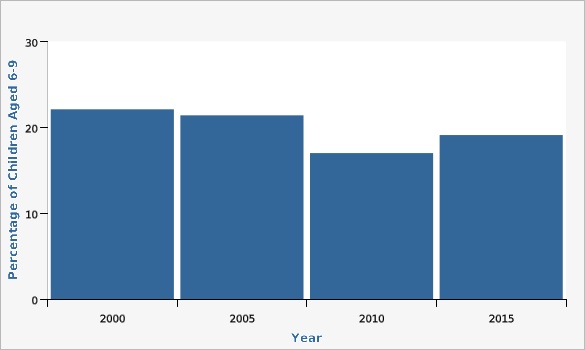
Of the first through fourth grade students screened in Utah in 2015, 19.1% had obvious untreated decay. In comparison the CDC says the percent of children aged 5-19 years with untreated dental caries was 18.6% (2011-2014).What Is Being Done?
Some Utah Department of Health activities addressing access to dental care include: * In 2012 the number enrolled for Medicaid dental benefits was 169,000 children from birth through 18 years of age. * In 2012 the number enrolled in Children's Health Insurance Program (CHIP) was 36,000 children eligible for basic dental services. * The Utah Oral Health Initiative facilitates the formation of local oral health coalitions to improve access to dental care.Available Services
As of September 2017, Medicaid includes basic dental care for children, pregnant women, and disabled adults. There is only emergency coverage for most other adults. For information call 801-538-6155, or 1-800-662-9651 or visit [https://medicaid.utah.gov/]. CHIP includes preventive and restorative services for children. For more information call 1-877-KIDS-NOW or visit [http://health.utah.gov/chip/]. There are a few dental clinics that provide services on a sliding fee scale or at a reduced rate. For more information on these clinics, contact your local health department or the State Oral Health Program at (801) 273-2995, or visit the [http://health.utah.gov/oralhealth/dentist.php Oral Health Program - Find a Dentist] website. Dental Hygiene Schools throughout the state of Utah offer preventive services including sealants and fluoride treatments. Dental Schools also offer treatment services in addition. Contact the UDOH Oral Health Program at (801) 273-2995, or visit the [http://health.utah.gov/oralhealth Oral Health Program] website for more information. [http://www.healthypeople.gov/2020/topics-objectives/topic/oral-health Link for Healthy People 2020 for Oral Health]Health Program Information
For other oral health related reports, click on the Health Topics tab, then click on Dental, then click on the + to the right of Publications.Related Indicators
Relevant Population Characteristics
Dental disease affects children from poor families five times as much as children from higher income families. Minority ethnic populations have a higher incidence of caries experience and untreated caries but a lower rate of sealant placement.Related Relevant Population Characteristics Indicators:
Health Care System Factors
Private dental insurance has improved access to dental care for many people. Medicaid and CHIP serve low income children; however, access remains a barrier to treatment. Individuals without dental insurance coverage have more untreated decay and were twice as likely to report that they could not access needed dental treatment during the past year.Related Health Care System Factors Indicators:
Risk Factors
Currently, only 52% of Utahns are drinking optimum fluoridated water. Other risk factors include eating habits, such as frequent snacking and pop consumption, not brushing/flossing regularly, and not visiting the dentist regularly.Related Risk Factors Indicators:
Health Status Outcomes
Oral disease has been linked to several other chronic diseases, including cardiovascular disease and diabetes.Related Health Status Outcomes Indicators:
Graphical Data Views
Percentage of 6- to 9-year-old Children With Untreated Dental Caries, Utah, 2000-2015

| Year | Percentage of Children Aged 6-9 | Lower Limit | Upper Limit | |||
|---|---|---|---|---|---|---|
Record Count: 4 | ||||||
| 2000 | 22.1% | 19.9% | 24.3% | |||
| 2005 | 21.4% | 18.9% | 23.9% | |||
| 2010 | 17.0% | 15.4% | 18.7% | |||
| 2015 | 19.1% | 15.4% | 22.8% | |||
Data Notes
It was planned to complete the next survey during the 2020-21 school year, but due to the COVID-19 pandemic it was cancelled. The date of the next survey is uncertain and depends on multiple factors including the length of the pandemic and future funding for the survey. 2000 and 2005 data are for ages 6 to 8 years.Data Source
Utah Oral Health Survey, Utah Department of HealthMore Resources and Links
Evidence-based community health improvement ideas and interventions may be found at the following sites:- Centers for Disease Control and Prevention (CDC) WONDER Database, a system for disseminating public health data and information.
- United States Census Bureau data dashboard.
- Utah healthy Places Index, evidence-based and peer-reviewed tool, supports efforts to prioritize equitable community investments, develop critical programs and policies across the state, and much more.
- County Health Rankings
- Kaiser Family Foundation's StateHealthFacts.org
- Medical literature can be queried at PubMed library.
Page Content Updated On 10/26/2020,
Published on 02/04/2021