
Complete Health Indicator Report of Refugee Arrivals
Definition
Number of refugee arrivals. Arrival numbers include all populations supported by the Office of Refugee Resettlement.Numerator
Number of refugee arrivals.Denominator
Not applicable.Why Is This Important?
A refugee is any person who is unable or unwilling to return to their country because of fear of persecution on account of race, religion, nationality, membership in a particular social group, or political opinion. Refugees often flee their homes with very few possessions and may spend years in refugee camps living under very difficult conditions prior to being resettled in the U.S. It is important to understand newly-settled populations and the health problems common to the areas they have arrived from to identify conditions of public health significance and other chronic health conditions that may adversely affect resettlement.Other Objectives
The Refugee Federal Act of 1980 entitles each newly arriving refugee to a complete health screening within the first 30-90 days after arriving in the U.S. The health screening focuses on the following categories of risk assessment and health promotion: [[br]] *tuberculosis *hepatitis B *parasites *HIV/AIDS *STDs *anemia *diabetes *hypertension *cardiovascular disease *lead screening *immunizations *pregnancy *hearing acuity *visual acuity *mental health conditions, including post-traumatic stress disorder *any infectious disease that may be present in the country arriving fromHow Are We Doing?
Health Screening Compliance and Tuberculosis (TB) Screen Follow-up: [[br]] *Refugees receive a health screening within 30-90 days of arrival *All refugees are screened for TB *All those with positive TB screen receive a chest X-ray and full TB evaluationHow Do We Compare With the U.S.?
More than two million refugees have arrived in the U.S. since the Federal Refugee Act of 1980 was established. These arrivals were primarily from Southeast Asia and the Soviet Union in the 1970s and 1980s during the Cold War period, followed by Europe in the 1990s during the Balkans period, and now a growing number from Africa in the 2000s during the civil conflict and from the Middle East as a result of the current conflict. Utah has resettled over 25,000 refugee cases since 1995 and ranks in the top 25 for refugee arrivals in the U.S.What Is Being Done?
The primary goal of the Utah Department of Health and Human Services Refugee Health Program is to offer health screening related services to all newly arriving refugees and newcomers in Utah. This is accomplished by working closely with the refugee resettlement agencies and with the health screening clinics and providers.Evidence-based Practices
The refugee health screening process of newly arriving refugees to Utah is conducted in accordance with the [https://www.cdc.gov/immigrantrefugeehealth/guidelines/domestic-guidelines.html CDC Guidelines for the U.S. Domestic Medical Examination for Newly Arriving Refugees] and [https://drive.google.com/file/d/101-vkyV8jq_5NMqRmZn1EtqkykPD_78l/view Utah Refugee Health Screening Provider Resource Guide]Available Services
Catholic Community Services - Utah[[br]] 224 N. 2400 W.[[br]] Salt Lake City, UT 84116[[br]] Phone: (801) 977-9119[[br]] Fax: (801) 977-9224[[br]] [[br]] International Rescue Committee[[br]] 221 South 400 West[[br]] Salt Lake City, UT 84101[[br]] Phone: (801) 328-1091[[br]] Fax: (801) 328-1094[[br]] [[br]] Refugee & Immigrant Center - Asian Association of Utah[[br]] 155 South 300 West[[br]] Salt Lake City, UT 84101[[br]] Phone: (801) 467-6060[[br]] Fax: (801) 486-3007[[br]] [[br]] Refugee Services Office[[br]] Utah Department of Workforce Services[[br]] 150 N 1950 W[[br]] Salt Lake City, UT 84116[[br]] Phone: (801) 618-5096[[br]] [[br]] Cache Refugee and Immigrant Connection[[br]] 1115 N 200 E Suite 130[[br]] Logan, UT 84341[[br]] Main office: (435) 915-6689[[br]] Client Support: (435) 612-2246[[br]] [[br]]Graphical Data Views
Number of refugee arrivals by sex, Utah, 2015-2023
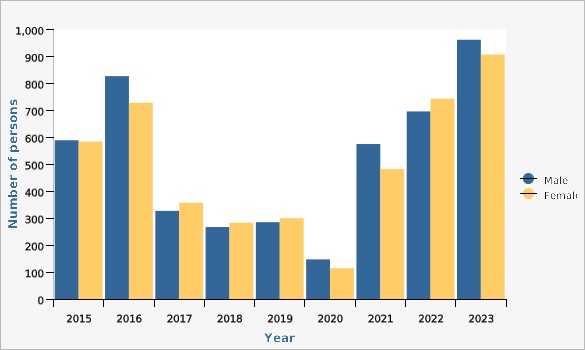
| Males vs. Females | Year | Number of persons | ||||
|---|---|---|---|---|---|---|
Record Count: 18 | ||||||
| Male | 2015 | 589 | ||||
| Male | 2016 | 827 | ||||
| Male | 2017 | 327 | ||||
| Male | 2018 | 267 | ||||
| Male | 2019 | 285 | ||||
| Male | 2020 | 147 | ||||
| Male | 2021 | 575 | ||||
| Male | 2022 | 696 | ||||
| Male | 2023 | 962 | ||||
| Female | 2015 | 584 | ||||
| Female | 2016 | 728 | ||||
| Female | 2017 | 357 | ||||
| Female | 2018 | 283 | ||||
| Female | 2019 | 300 | ||||
| Female | 2020 | 114 | ||||
| Female | 2021 | 482 | ||||
| Female | 2022 | 743 | ||||
| Female | 2023 | 907 | ||||
Data Source
Utah Department of Health and Human Services Office of Communicable DiseasesNumber of Refugee Arrivals, Utah, 1998-2023
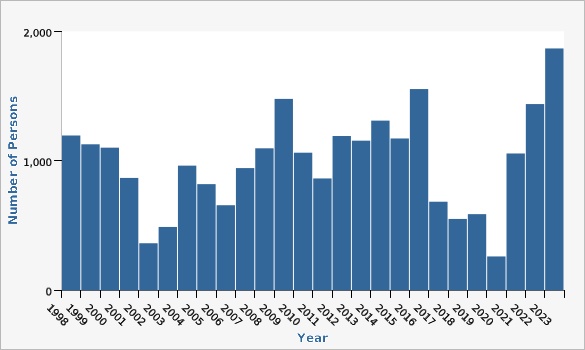
| Year | Number of Persons | |||||
|---|---|---|---|---|---|---|
Record Count: 26 | ||||||
| 1998 | 1,196 | |||||
| 1999 | 1,128 | |||||
| 2000 | 1,102 | |||||
| 2001 | 868 | |||||
| 2002 | 363 | |||||
| 2003 | 489 | |||||
| 2004 | 963 | |||||
| 2005 | 820 | |||||
| 2006 | 657 | |||||
| 2007 | 944 | |||||
| 2008 | 1,097 | |||||
| 2009 | 1,479 | |||||
| 2010 | 1,063 | |||||
| 2011 | 864 | |||||
| 2012 | 1,192 | |||||
| 2013 | 1,156 | |||||
| 2014 | 1,311 | |||||
| 2015 | 1,173 | |||||
| 2016 | 1,555 | |||||
| 2017 | 684 | |||||
| 2018 | 551 | |||||
| 2019 | 588 | |||||
| 2020 | 261 | |||||
| 2021 | 1,057 | |||||
| 2022 | 1,439 | |||||
| 2023 | 1,869 | |||||
Data Source
Utah Department of Health and Human Services Office of Communicable DiseasesNumber of Reportable Conditions in Refugee Arrivals, Utah, 1998-2023
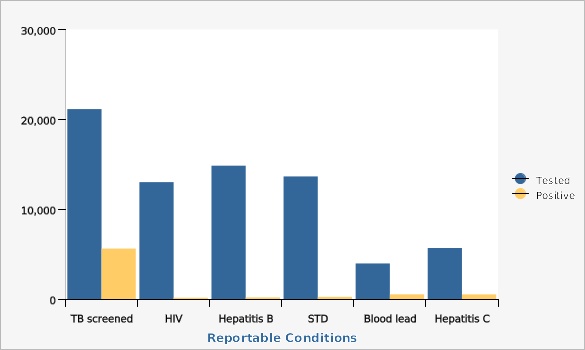
| Tested vs. Positive | Reportable Conditions | |||||
|---|---|---|---|---|---|---|
Record Count: 12 | ||||||
| Tested | TB screened | 21,141 | ||||
| Tested | HIV | 13,011 | ||||
| Tested | Hepatitis B | 14,840 | ||||
| Tested | STD | 13,645 | ||||
| Tested | Blood lead | 3,958 | ||||
| Tested | Hepatitis C | 5,676 | ||||
| Positive | TB screened | 5,612 | ||||
| Positive | HIV | 143 | ||||
| Positive | Hepatitis B | 176 | ||||
| Positive | STD | 239 | ||||
| Positive | Blood lead | 521 | ||||
| Positive | Hepatitis C | 513 | ||||
Data Notes
Tuberculin Skin Test (TST) and interferon-gamma release assay (IGRA) were conducted to screen for latent tuberculosis infection (LTBI). Positive cases on the TB screening were all LTBI cases (active disease was ruled out by chest x-ray, three sputum smears, and/or three cultures for M. tuberculosis as clinically indicated). All cases 16 years old or younger were tested for blood lead level, starting in 2021 - a reference level of 3.5 micrograms per deciliter or more was considered positive. Prior to 2021, the reference level was 5 micrograms per deciliter or more as considered positive.Data Source
Utah Department of Health and Human Services Office of Communicable DiseasesNumber of Refugee Arrivals by Resettlement Agency, Utah, 2015-2023
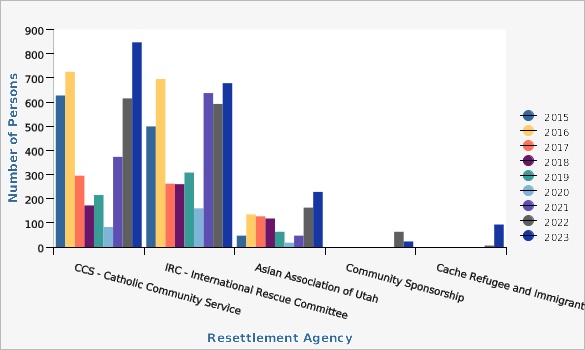
| Year | Resettlement Agency | Number of Persons | ||||
|---|---|---|---|---|---|---|
Record Count: 31 | ||||||
| 2015 | CCS - Catholic Community Service | 627 | ||||
| 2015 | IRC - International Rescue Committee | 499 | ||||
| 2015 | Asian Association of Utah | 47 | ||||
| 2016 | CCS - Catholic Community Service | 725 | ||||
| 2016 | IRC - International Rescue Committee | 695 | ||||
| 2016 | Asian Association of Utah | 135 | ||||
| 2017 | CCS - Catholic Community Service | 295 | ||||
| 2017 | IRC - International Rescue Committee | 262 | ||||
| 2017 | Asian Association of Utah | 127 | ||||
| 2018 | CCS - Catholic Community Service | 172 | ||||
| 2018 | IRC - International Rescue Committee | 260 | ||||
| 2018 | Asian Association of Utah | 118 | ||||
| 2019 | CCS - Catholic Community Service | 215 | ||||
| 2019 | IRC - International Rescue Committee | 308 | ||||
| 2019 | Asian Association of Utah | 63 | ||||
| 2020 | CCS - Catholic Community Service | 83 | ||||
| 2020 | IRC - International Rescue Committee | 160 | ||||
| 2020 | Asian Association of Utah | 18 | ||||
| 2021 | CCS - Catholic Community Service | 373 | ||||
| 2021 | IRC - International Rescue Committee | 637 | ||||
| 2021 | Asian Association of Utah | 47 | ||||
| 2022 | CCS - Catholic Community Service | 615 | ||||
| 2022 | IRC - International Rescue Committee | 592 | ||||
| 2022 | Asian Association of Utah | 163 | ||||
| 2022 | Community Sponsorship | 63 | ||||
| 2022 | Cache Refugee and Immigrant Connection | 6 | ||||
| 2023 | CCS - Catholic Community Service | 847 | ||||
| 2023 | IRC - International Rescue Committee | 678 | ||||
| 2023 | Asian Association of Utah | 228 | ||||
| 2023 | Community Sponsorship | 23 | ||||
| 2023 | Cache Refugee and Immigrant Connection | 93 | ||||
Data Source
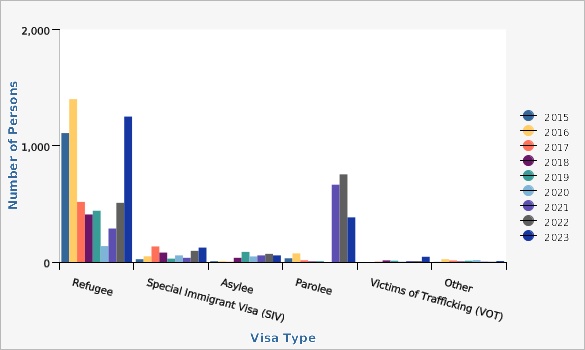
Utah Department of Health and Human Services Office of Communicable DiseasesNumber of Refugee Arrivals by Visa Type, Utah, 2015-2023
| Year | Visa Type | Number of Persons | ||||
|---|---|---|---|---|---|---|
Record Count: 51 | ||||||
| 2015 | Refugee | 1,109 | ||||
| 2015 | Special Immigrant Visa (SIV) | 24 | ||||
| 2015 | Asylee | 7 | ||||
| 2015 | Parolee | 32 | ||||
| 2015 | Other | 1 | ||||
| 2016 | Refugee | 1,401 | ||||
| 2016 | Special Immigrant Visa (SIV) | 49 | ||||
| 2016 | Asylee | 7 | ||||
| 2016 | Parolee | 74 | ||||
| 2016 | Other | 24 | ||||
| 2017 | Refugee | 517 | ||||
| 2017 | Special Immigrant Visa (SIV) | 134 | ||||
| 2017 | Asylee | 2 | ||||
| 2017 | Parolee | 15 | ||||
| 2017 | Victims of Trafficking (VOT) | 3 | ||||
| 2017 | Other | 13 | ||||
| 2018 | Refugee | 409 | ||||
| 2018 | Special Immigrant Visa (SIV) | 81 | ||||
| 2018 | Asylee | 36 | ||||
| 2018 | Parolee | 5 | ||||
| 2018 | Victims of Trafficking (VOT) | 14 | ||||
| 2018 | Other | 5 | ||||
| 2019 | Refugee | 441 | ||||
| 2019 | Special Immigrant Visa (SIV) | 29 | ||||
| 2019 | Asylee | 87 | ||||
| 2019 | Parolee | 7 | ||||
| 2019 | Victims of Trafficking (VOT) | 11 | ||||
| 2019 | Other | 11 | ||||
| 2020 | Refugee | 137 | ||||
| 2020 | Special Immigrant Visa (SIV) | 57 | ||||
| 2020 | Asylee | 48 | ||||
| 2020 | Victims of Trafficking (VOT) | 3 | ||||
| 2020 | Other | 16 | ||||
| 2021 | Refugee | 288 | ||||
| 2021 | Special Immigrant Visa (SIV) | 36 | ||||
| 2021 | Asylee | 57 | ||||
| 2021 | Parolee | 665 | ||||
| 2021 | Victims of Trafficking (VOT) | 8 | ||||
| 2021 | Other | 3 | ||||
| 2022 | Refugee | 509 | ||||
| 2022 | Special Immigrant Visa (SIV) | 96 | ||||
| 2022 | Asylee | 70 | ||||
| 2022 | Parolee | 754 | ||||
| 2022 | Victims of Trafficking (VOT) | 8 | ||||
| 2022 | Other | 2 | ||||
| 2023 | Refugee | 1,251 | ||||
| 2023 | Special Immigrant Visa (SIV) | 124 | ||||
| 2023 | Asylee | 57 | ||||
| 2023 | Parolee | 384 | ||||
| 2023 | Victims of Trafficking (VOT) | 45 | ||||
| 2023 | Other | 8 | ||||
Data Source
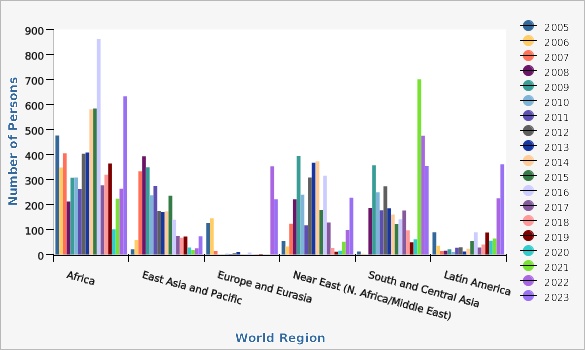
Utah Department of Health and Human Services Office of Communicable DiseasesNumber of Refugee Arrivals by Region, Utah 2005-2023
| Year | World Region | Number of Persons | ||||
|---|---|---|---|---|---|---|
Record Count: 110 | ||||||
| 2005 | Africa | 476 | ||||
| 2005 | East Asia and Pacific | 21 | ||||
| 2005 | Europe and Eurasia | 126 | ||||
| 2005 | Near East (N. Africa/Middle East) | 54 | ||||
| 2005 | South and Central Asia | 12 | ||||
| 2005 | Latin America | 89 | ||||
| 2006 | Africa | 348 | ||||
| 2006 | East Asia and Pacific | 58 | ||||
| 2006 | Europe and Eurasia | 145 | ||||
| 2006 | Near East (N. Africa/Middle East) | 32 | ||||
| 2006 | South and Central Asia | 3 | ||||
| 2006 | Latin America | 35 | ||||
| 2007 | Africa | 405 | ||||
| 2007 | East Asia and Pacific | 333 | ||||
| 2007 | Europe and Eurasia | 14 | ||||
| 2007 | Near East (N. Africa/Middle East) | 123 | ||||
| 2007 | South and Central Asia | 0 | ||||
| 2007 | Latin America | 14 | ||||
| 2008 | Africa | 212 | ||||
| 2008 | East Asia and Pacific | 393 | ||||
| 2008 | Europe and Eurasia | 0 | ||||
| 2008 | Near East (N. Africa/Middle East) | 221 | ||||
| 2008 | South and Central Asia | 186 | ||||
| 2008 | Latin America | 15 | ||||
| 2009 | Africa | 307 | ||||
| 2009 | East Asia and Pacific | 349 | ||||
| 2009 | Europe and Eurasia | 0 | ||||
| 2009 | Near East (N. Africa/Middle East) | 394 | ||||
| 2009 | South and Central Asia | 357 | ||||
| 2009 | Latin America | 21 | ||||
| 2010 | Africa | 308 | ||||
| 2010 | East Asia and Pacific | 237 | ||||
| 2010 | Europe and Eurasia | 3 | ||||
| 2010 | Near East (N. Africa/Middle East) | 239 | ||||
| 2010 | South and Central Asia | 249 | ||||
| 2010 | Latin America | 10 | ||||
| 2011 | Africa | 262 | ||||
| 2011 | East Asia and Pacific | 274 | ||||
| 2011 | Europe and Eurasia | 2 | ||||
| 2011 | Near East (N. Africa/Middle East) | 117 | ||||
| 2011 | South and Central Asia | 177 | ||||
| 2011 | Latin America | 27 | ||||
| 2012 | Africa | 403 | ||||
| 2012 | East Asia and Pacific | 174 | ||||
| 2012 | Europe and Eurasia | 5 | ||||
| 2012 | Near East (N. Africa/Middle East) | 308 | ||||
| 2012 | South and Central Asia | 273 | ||||
| 2012 | Latin America | 29 | ||||
| 2013 | Africa | 408 | ||||
| 2013 | East Asia and Pacific | 170 | ||||
| 2013 | Europe and Eurasia | 10 | ||||
| 2013 | Near East (N. Africa/Middle East) | 367 | ||||
| 2013 | South and Central Asia | 185 | ||||
| 2013 | Latin America | 12 | ||||
| 2014 | Africa | 581 | ||||
| 2014 | East Asia and Pacific | 173 | ||||
| 2014 | Europe and Eurasia | 1 | ||||
| 2014 | Near East (N. Africa/Middle East) | 373 | ||||
| 2014 | South and Central Asia | 160 | ||||
| 2014 | Latin America | 23 | ||||
| 2015 | Africa | 584 | ||||
| 2015 | East Asia and Pacific | 235 | ||||
| 2015 | Near East (N. Africa/Middle East) | 178 | ||||
| 2015 | South and Central Asia | 122 | ||||
| 2015 | Latin America | 54 | ||||
| 2016 | Africa | 862 | ||||
| 2016 | East Asia and Pacific | 139 | ||||
| 2016 | Europe and Eurasia | 8 | ||||
| 2016 | Near East (N. Africa/Middle East) | 315 | ||||
| 2016 | South and Central Asia | 141 | ||||
| 2016 | Latin America | 89 | ||||
| 2017 | Africa | 277 | ||||
| 2017 | East Asia and Pacific | 74 | ||||
| 2017 | Near East (N. Africa/Middle East) | 128 | ||||
| 2017 | South and Central Asia | 176 | ||||
| 2017 | Latin America | 28 | ||||
| 2018 | Africa | 319 | ||||
| 2018 | East Asia and Pacific | 67 | ||||
| 2018 | Europe and Eurasia | 1 | ||||
| 2018 | Near East (N. Africa/Middle East) | 26 | ||||
| 2018 | South and Central Asia | 97 | ||||
| 2018 | Latin America | 40 | ||||
| 2019 | Africa | 364 | ||||
| 2019 | East Asia and Pacific | 72 | ||||
| 2019 | Europe and Eurasia | 2 | ||||
| 2019 | Near East (N. Africa/Middle East) | 11 | ||||
| 2019 | South and Central Asia | 49 | ||||
| 2019 | Latin America | 88 | ||||
| 2020 | Africa | 101 | ||||
| 2020 | East Asia and Pacific | 28 | ||||
| 2020 | Near East (N. Africa/Middle East) | 15 | ||||
| 2020 | South and Central Asia | 61 | ||||
| 2020 | Latin America | 55 | ||||
| 2021 | Africa | 223 | ||||
| 2021 | East Asia and Pacific | 18 | ||||
| 2021 | Near East (N. Africa/Middle East) | 51 | ||||
| 2021 | South and Central Asia | 701 | ||||
| 2021 | Latin America | 64 | ||||
| 2022 | Africa | 263 | ||||
| 2022 | East Asia and Pacific | 25 | ||||
| 2022 | Europe and Eurasia | 353 | ||||
| 2022 | Near East (N. Africa/Middle East) | 98 | ||||
| 2022 | South and Central Asia | 475 | ||||
| 2022 | Latin America | 225 | ||||
| 2023 | Africa | 633 | ||||
| 2023 | East Asia and Pacific | 73 | ||||
| 2023 | Europe and Eurasia | 221 | ||||
| 2023 | Near East (N. Africa/Middle East) | 227 | ||||
| 2023 | South and Central Asia | 354 | ||||
| 2023 | Latin America | 361 | ||||
Data Source
Utah Department of Health and Human Services Office of Communicable DiseasesNumber of refugee arrivals by age group, Utah, 2015-2023
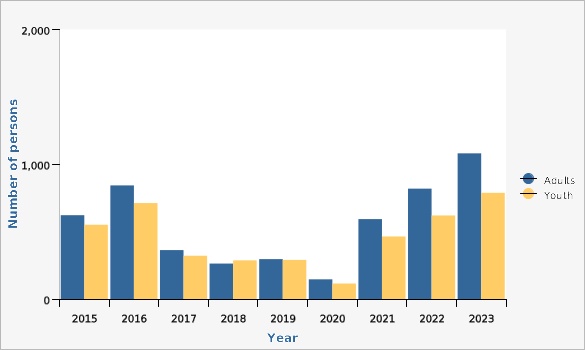
{{style color:#003366 Adults are refugees whose ages at arrival were 18 or older. }}
[[br]] {{style color:#003366 Youths are refugees whose ages at arrival were younger than 18.}}
| Adults vs. Youth | Year | Number of persons | ||||
|---|---|---|---|---|---|---|
Record Count: 18 | ||||||
| Adults | 2015 | 622 | ||||
| Adults | 2016 | 843 | ||||
| Adults | 2017 | 363 | ||||
| Adults | 2018 | 263 | ||||
| Adults | 2019 | 296 | ||||
| Adults | 2020 | 146 | ||||
| Adults | 2021 | 593 | ||||
| Adults | 2022 | 819 | ||||
| Adults | 2023 | 1,081 | ||||
| Youth | 2015 | 551 | ||||
| Youth | 2016 | 712 | ||||
| Youth | 2017 | 321 | ||||
| Youth | 2018 | 287 | ||||
| Youth | 2019 | 290 | ||||
| Youth | 2020 | 115 | ||||
| Youth | 2021 | 464 | ||||
| Youth | 2022 | 620 | ||||
| Youth | 2023 | 788 | ||||
Data Source
Utah Department of Health and Human Services Office of Communicable DiseasesReferences and Community Resources
[[br]] ====INTERNET RESOURCES FOR REFUGEES==== Utah Department of Health and Human Services[[br]] Refugee Health Program[[br]] [https://epi.health.utah.gov/refugee-health/] Catholic Community Services - Utah[[br]] [http://www.ccsutah.org] International Rescue Committee[[br]] [https://www.rescue.org/united-states/salt-lake-city-ut] Cache Refugee and Immigrant Connection[[br]] [http://www.cacherefugees.org] U.S. Department of Health & Human Services, Office of Refugee Resettlement[[br]] [http://www.acf.hhs.gov/programs/orr] U.S. Department of State, Bureau of Population, Refugees, and Migration[[br]] [http://www.state.gov/g/prm] Utah Department of Workforce Services, Utah Refugee Resettlement Program[[br]] [https://jobs.utah.gov/refugee/]More Resources and Links
Evidence-based community health improvement ideas and interventions may be found at the following sites:- Centers for Disease Control and Prevention (CDC) WONDER Database, a system for disseminating public health data and information.
- United States Census Bureau data dashboard.
- Utah healthy Places Index, evidence-based and peer-reviewed tool, supports efforts to prioritize equitable community investments, develop critical programs and policies across the state, and much more.
- County Health Rankings
- Kaiser Family Foundation's StateHealthFacts.org
- Medical literature can be queried at PubMed library.
Page Content Updated On 02/22/2024,
Published on 03/11/2024