
Complete Health Indicator Report of Sexual Violence
Definition
__Rape Revised__: Penetration, no matter how slight, of the vagina or anus with any body part or object, or oral penetration by a sex organ of another person, without the consent of the victim. __Rape Legacy__: Forcible rape is the carnal knowledge of a female forcibly and against her will. Assaults and attempts to commit rape by force or threat of force are also included; however, statutory rape (without force) and other sex offenses are excluded.Numerator
__Rape Revised__: Number of rapes reported to law enforcement that meet the '''revised''' definition. __Rape Legacy__: Number of rapes reported to law enforcement that meet the '''legacy''' definition.Denominator
__Rape Revised__: Total number of adult persons in Utah. __Rape Legacy__: Total number of adult persons in Utah.Data Interpretation Issues
'''Revised Definition''': Penetration, no matter how slight, of the vagina or anus with any body part or object, or oral penetration by a sex organ of another person, without the consent of the victim reported to law enforcement. [[br]]'''Legacy Definition''': Forcible rape is the carnal knowledge of a female forcibly and against her will. Assaults and attempts to commit rape by force or threat of force are also included; however, statutory rape (without force) and other sex offenses are excluded. At the state level, the Federal Bureau of Investigation Uniform Crime Reporting Program began reporting the revised definition in 2013. They stopped reporting the legacy definition at the state level in 2016. Statistics vary because of differences in how rape is defined and how data is collected. The rape rate includes only those that have been reported to law enforcement and is an underestimate of the actual rape rate. Some law enforcement agencies do not submit a full 12 months of data and some agencies do not submit any data at all. The numerator of the rate is by county of occurrence, not county of residence.Why Is This Important?
Sexual violence in Utah is a serious public health problem affecting thousands of residents each year. Studies in Utah suggest that one in six women and one in 25 men experience rape or attempted rape during their lifetime^1^ and nearly one in three women will experience some form of sexual violence during their lives.^2, 3^ Rape is the only violent crime in Utah that is higher than the national average. In a state where other violent crimes, such as homicide, robbery, or aggravated assault, are historically half to three times lower than the national average, this is of concern.^2^ The costs resulting from sexual violence in 2011 totaled nearly $5 billion, almost $1,700 per Utah resident. The Utah state government spent more than $92 million on people known to have perpetrated sexual violence. Only $569,000 was spent on efforts to prevent sexual violence.^4^ More needs to be done to prevent sexual violence in our communities. The Utah Department of Health has identified priority risk and protective factors for preventing sexual violence in Utah: [[br]] *Societal norms that support violence/sexual violence[[br]] *Adherence to traditional gender norms[[br]] *Gender equity[[br]] *Association with pro-social peers[[br]] *Skill-solving problems in a non-violent manner[[br]] *Community support and connectedness [[br]][[br]] ---- 1) Utah Behavioral Risk Factor Surveillance System. (2018). Sexual Violence [Data file]. Retrieved from: Utah Department of Health. [[br]] 2) Mitchell, C., Peterson, B. (2007). Rape in Utah. Utah Commission on Criminal and Juvenile Justice. Accessed 10/6/2017: [https://justice.utah.gov/Documents/Research/SexOffender/RapeinUtah2007.pdf]. [[br]] 3) Smith, S.G., Chen, J., Basile, K.C., Gilbert, L.K., Merrick, M.T., Patel, N., Walling, M., & Jain, A. (2017). The National Intimate Partner and Sexual Violence Survey (NISVS): 2010-2012 State Report. Atlanta, GA: National Center for Injury Prevention and Control, Centers for Disease Control and Prevention. Retrieved from: [https://www.cdc.gov/violenceprevention/pdf/NISVS-StateReportBook.pdf]. [[br]] 4) Utah Violence and Injury Prevention Program. Costs of Sexual Violence in Utah 2015. Salt Lake City, UT: Utah Department of Health, 2015 Retrieved from: [http://www.health.utah.gov/vipp/pdf/RapeSexualAssault/costs-sexual-violence-report.pdf]. [[br]]Healthy People Objective IVP-40.1:
(Developmental) Reduce rape or attempted rapeU.S. Target: Developmental
State Target: 11.2 percent of females reported rape or attempted rape
Other Objectives
Subobjectives for Healthy People Objective 2030 include: ====Healthy People 2030 IVP-17:==== Reduce adolescent sexual violence by anyoneHow Are We Doing?
In 2016, an estimated 23.2% of rape or sexual assault were reported to police.^1^ This clearly indicates that sexual violence rates are under reported. It is important to keep this in mind when referring to federal and state crime reports and statistics. Among Utah high schools, 14.3% of students report experiencing sexual violence in the past 12 months. Additionally, 7.3% of students experienced forced sexual intercourse. National research estimates that eight out of ten rape victims report they were first raped before they turned 25, and four out of ten rape victims report they were first raped before their 18th birthday.^2^ From 2016 to 2018, Utah Department of Safety reported that Duchesne, Salt Lake, and Tooele counties had significantly higher reported rape rates than the state rate of 44.3 per 100,000 female population.^3^ Rape affects the quality of life and may have lasting consequences for victims. In the 2018 Behavioral Risk Factor Surveillance Survey, 14.7% of respondents indicated that they experienced a form of sexual abuse as a child. This was significantly higher for females (19.8%) compared to males (9.4%).^4^ In 2018, those who report lifetime rape were significantly more likely to have seven or more poor mental health days (42.8% vs. 15.5%), miss more than seven days of work or activities (28.6% vs. 13.4%), have difficulty concentrating or remembering (26.5% vs. 9.1%), binge drink (16.6% vs. 10.2%), smoke every day (13.4% vs. 4.9%), have difficulty doing errands alone (15.9% vs. 3.5%), and have poor health (6.8% vs. 3.1%) compared to those who have not experienced lifetime rape.^4^ The 2016 Utah Behavioral Risk Factor Surveillance System showed that the majority of rape victims (87.8%) previously knew their perpetrator, only 3.9% reported they were on a first date, 2.0% reported they knew the person for less than 24 hours, and 6.3% reported their perpetrator was a complete stranger.^4^ [[br]] [[br]] ---- 1) Morgan, R., Kena, G. (2018). Criminal Victimization, 2016: Revised. Accessed 10/31/2019: [https://www.bjs.gov/content/pub/pdf/cv16.pdf]. [[br]] 2) Breiding, M. J., Smith, S. G., Basile, K. C., Walters, M. L., Chen, J., & Merrick, M. T. (2014, September 5). Prevalence and characteristics of sexual violence, stalking, and intimate partner violence victimization - National Intimate Partner and Sexual Violence Survey, United States, 2011. Morbidity and Mortality Weekly Report, 63(SS08), 1-18. Retrieved from [https://www.cdc.gov/mmwr/preview/mmwrhtml/ss6308a1.htm].[[br]] 3) Utah Department of Public Safety. Bureau of Criminal Identification CIU 2016-2018 Reports. Salt Lake City, UT. Accessed: 10/31/2019: [https://bci.utah.gov/utah-crime-statistics/]. [[br]] 4) Utah Behavioral Risk Factor Surveillance System. Sexual Violence [Data file]. Retrieved from: Utah Department of Health. [[br]]How Do We Compare With the U.S.?
According to Federal Bureau of Investigation, the rape rate in Utah has been consistently higher than the U.S. rate. In 2019, the reported rape rate in Utah was significantly higher than the U.S. rate at 56.8 per 100,000 adults, compared to 42.6 per 100,000 adults.^1^ [[br]] [[br]] ---- 1) Federal Bureau of Investigation (2019). Crime Data Explorer. Accessed 10/25/2020: [https://crime-data-explorer.fr.cloud.gov/explorer/state/utah/crime].What Is Being Done?
The Utah Department of Health Violence and Injury Prevention Program (VIPP) and the Utah Coalition Against Sexual Assault (UCASA) collaborated in 1999 to enlist individuals, organizations, and agencies to participate in a statewide multi-disciplinary council addressing sexual violence. In 2003, the Utah Sexual Violence Council (USVC) was formed. The USVC still exists today and functions as a multi-disciplinary, statewide advisory council that promotes a climate where sexual violence is addressed as a priority issue that impacts all Utah communities. Its vision is to change social norms and improve Utah's understanding of the overwhelming significance of this public health, social service, and criminal justice problem. Since 2000, the VIPP has received Rape Prevention and Education Grant funding from the U.S. Centers for Disease Control and Prevention. The intent of the program is to work on the outer-levels of the social ecology (community, societal) and use approaches informed by identified risk and protective factors to reduce perpetration of sexual violence. In 2016 and 2017, the Utah State Legislature appropriated funds from the Temporary Assistance for Needy Families (TANF) Program, housed by the Utah Department of Workforce Services. These funds aim to expand the ongoing primary prevention efforts, by increasing the number of projects in underserved regions of the state, as well as increasing programming for underserved communities, including rural communities, tribal communities, LGBTQ populations, and underserved and high risk groups. In 2019, the Legislature appropriated one-time one-year state general funds for the prevention of sexual and intimate partners violence. These funds are supporting the implementation of prevention efforts in seven communities, as well as the organization of a state collaborative effort to scale prevention work across the state. Prevention efforts in Utah focus on reducing risk factors and increasing protective factors for sexual violence.^1^ These factors are associated with sexual violence, but may not be a direct cause of victimization or perpetration. Priority risk and protective factors in Utah include: societal norms that support violence and sexual violence; harmful norms around masculinity and femininity; lack of skill in solving problems non-violently; societal and community support and connectedness; and emotional health and connectedness. [[br]] [[br]] ---- 1) Centers for Disease Control and Prevention. Sexual Violence: Risk and Protective Factors. Atlanta, GA: National Center for Injury Prevention and Control, Division of Violence Prevention, 2017. Accessed 10/20/2017: [https://www.cdc.gov/violenceprevention/sexualviolence/riskprotectivefactors.html].Evidence-based Practices
Several strategies have demonstrated evidence for preventing sexual violence perpetration. A systematic review conducted by the CDC Injury Center has identified effective or promising strategies and approaches which have been compiled in their STOP SV Technical Package. A summary of this package and high-level overview of best practice strategies can be found at [https://www.cdc.gov/violenceprevention/sexualviolence/prevention.html]. Within each approach listed below there are more specific programs that are considered evidence-based or promising practice that can be implemented or used to inform prevention work in communities. Approaches identified in the STOP SV Technical Package include:[[br]] [[br]] '''S''' - __Promote '''Social Norms''' that Protect Against Violence__[[br]] *Bystander intervention approaches ** Example: Bringing the Bystander, Green Dot *Mobilizing men and boys as allies ** Example: Coaching Boys into Men '''T''' - __'''Teaching''' Skills to Prevent Sexual Violence__ *Social emotional learning skills *Teaching healthy relationships, safe dating, and intimate relationships skills for adolescents **Example: Safe Dates *Promoting healthy sexuality *Empowerment-based training ''' O''' - __Provide '''Opportunities''' to Empower and Support Girls and Women__ *Strengthen economic supports for women and families *Strengthen leadership and opportunities for girls ''' P''' - __Create '''Protective''' Environments__ *Improving safety and monitoring in schools *Establishing and consistently applying workplace policies *Addressing community-level risks through environmental approaches [[br]] [[br]] The CDC recommends approaching sexual violence prevention by addressing risk and protective factors at various levels of the social ecology, especially when those risk and protective factors are shared between multiple forms of violence. Our social ecology describes the ways in which our environments, surroundings, and settings, interact with us as individuals and people. Some of those risk and protective factors include: [[br]] [[br]] __Risk:__[[br]] *Societal norms that support violence/sexual violence *Adherence to traditional gender norms *Gender inequality *General tolerance of sexual violence within community *Alcohol and drug use *Involvement in violence/abusive relationships *Social isolation/ lack of social support *Association with sexually aggressive, hyper-masculine, and delinquent peers *Hostility towards women *Childhood history of physical, sexual, emotional abuse *Suicidal thoughts and behavior *Risky sexual behavior *Traditional gender norms *Victim-blaming[[br]] [[br]] __Protective:__ *Association with Prosocial Peers *Skills in solving problems in a non-violent manner *Community Support *Emotional health and connectedness *Empathy and concern for how one's actions affect others *Self-efficacy for bystander intervention From [https://www.cdc.gov/violenceprevention/sexualviolence/riskprotectivefactors.html].[[br]] [[br]] A great resource for learning more about shared risk and protective factors and addressing multiple forms of violence is the Connecting the Dots tool at the CDC VetoViolence site: [[br]][https://vetoviolence.cdc.gov/apps/connecting-the-dots/]. Shared risk and protective factors apply to public health and prevention work outside of violence, as well. We can utilize risk and protective factor approaches along with social determinants of health to impact population-level change more broadly and further upstream.Available Services
^ ^ ====Statewide 24-hour Rape and Sexual Assault Crisis and Information Line 1-888-421-1100 ====[[br]] __ Cache & Rich Counties__[[br]] Citizens Against Physical and Sexual Abuse (CAPSA) 435-753-2500 __ Box Elder County__[[br]] New Hope Crisis Center 435-726-5600 __Davis County__[[br]] Safe Harbor 801-444-3191 (Business) and 801-444-9161 (Crisis) __Weber & Morgan Counties__[[br]] YCC, Ogden 801-394-9456 and 801-392-7273 (Crisis) __Salt Lake County__[[br]] Rape Recovery Center 801-467-7282 (Business) and 801-467-7273 (Crisis)[[br]] South Valley Services 801-255-1095 (24-hour), TTY/Text Helpline: 385-266-6208 __Tooele County__[[br]] Domestic Violence and Sexual Assault Victim Advocacy 435-843-3100 __Summit & Wasatch County__[[br]] Peace House 435-658-4739 (Business) 800-647-9161 (Crisis) __Juab, Utah, Wasatch Counties__[[br]] Center for Women and Children in Crisis 801-377-5500 __Iron, Beaver, & Garfield Counties__[[br]] Canyon Creek Services 435-865-7443 (Business) and 435-867-9411 (Crisis) __Washington & Kane Counties__[[br]] Dove Center 435-628-0458 __Sevier, Wayne, Piute, Millard, & Sanpete Counties__[[br]] New Horizons Crisis Center 435-896-9294 and 1-800-343-6302 (toll-free)) __Carbon & Emery Counties__[[br]] Family Support Center 435-636-3739 (Business) [[br]] Carbon County Sheriff's Office 435-636-3250 (Crisis & Victim Advocate) [[br]] Price City Policy Department 435-636-3190 (Crisis & Victim Advocate) __ Grand and San Juan Counties__[[br]] Seekhaven 435-259-2229 __San Juan County__[[br]] Victim Advocacy Program, Sheriff's Office 435-459-1819 __Uintah, Daggett, Duchesne Counties__[[br]] Vernal Victim Advocates 435-789-4250 and 435-789-4222 (after hours)Health Program Information
The Violence and Injury Prevention Program (VIPP) is a trusted and comprehensive resource for data related to violence and injury. Through education, this information helps promote partnerships and programs to prevent injuries and improve public health. The VIPP goals are to a) focus prevention efforts on reducing intentional and unintentional injury, b) conduct education aimed at increasing awareness and changing behaviors that contribute to the occurrence of injury, c) strengthen local health department capacity to conduct local injury prevention programs, d) promote legislation, policy changes, and enforcement that will reduce injury hazards and increase safe behaviors, e) collaborate with private and public partners, and f) improve the Utah Department of Health capacity to collect mortality and morbidity data from multiple sources and conduct injury epidemiology for use in prevention planning, implementation, and evaluation.Related Indicators
Relevant Population Characteristics
Nationally, nearly 1 in 5 women and 1 in 71 men reported experiencing rape at some time in their lives.^1^ Among adult women surveyed in 2010, 26.9% of American Indian/Alaska Native women, 22.0% of non-Hispanic Black women, 18.8% of non-Hispanic White women, 14.6% of Hispanic women, and 35.5% of women of multiple races experienced an attempted or a completed rape at some time in their lives.^1^ In 2017, among youth in Utah, 15.8% of Hispanic youth and 9.2% of White youth experienced being physically forced to have sexual intercourse. ^2^ [[br]] [[br]] ---- 1) National Intimate Partner and Sexual Violence Survey (2010). Accessed 10/22/2018: [https://www.cdc.gov/violenceprevention/nisvs/summaryreports.html]. [[br]] 2) Youth Risk Behavioral Survey (2017). Accessed 11/8/2019: [https://nccd.cdc.gov/youthonline/App/Results.aspx?LID=XX].Related Relevant Population Characteristics Indicators:
Health Care System Factors
According to the 2007 Rape in Utah Survey, only 12.7% of sexual assaults resulted in a visit to a doctor or medical center for an examination after the incident. Victims say they do not seek medical attention because they were not injured, they were too young to ask for help, they were afraid someone would find out what happened, and they were not thinking clearly. The main reasons for seeking medical care after a sexual assault were to be checked for a sexually transmitted infection, pregnancy, or to receive emergency contraception.[[br]] [[br]] ---- Utah Commission on Criminal and Juvenile Justice, ''2007 Rape in Utah Survey'' (accessed 1/4/2017), [https://justice.utah.gov/Violence/Documents/RapeinUtah2007.pdf]Related Health Care System Factors Indicators:
Risk Factors
Research has identified the following risk factors for sexual violence perpetration: alcohol and drug use, impulsive and antisocial tendencies, hostility towards women, history of sexual abuse as a child, witnessing family violence as a child, associating with sexually aggressive and delinquent peers, strongly patriarchal relationship or family environment, lack of employment opportunities, general tolerance of sexual assault within the community, weak community sanctions against perpetrators of sexual violence, societal norms that support sexual violence, male superiority and sexual entitlement, and weak laws and policies related to gender equity.[[br]] [[br]] ---- Department of Health and Human Services, Centers for Disease Control and Prevention, National Center for Injury Prevention and Control, Sexual Violence Fact Sheet (accessed 1/4/2017) [http://www.cdc.gov/ViolencePrevention/sexualviolence/riskprotectivefactors.html]Related Risk Factors Indicators:
Health Status Outcomes
Many long-lasting physical symptoms and illnesses have been associated with sexual victimization including chronic pelvic pain, premenstrual syndrome, gastrointestinal disorders, and a variety of chronic pain disorders, including headache, back pain, and facial pain. Immediate reactions to rape include shock, disbelief, denial, fear, confusion, anxiety, withdrawal, and symptoms of post-traumatic stress disorder. In addition, victims often experience anxiety, guilt, nervousness, phobias, substance abuse, sleep disturbances, depression, alienation, and sexual dysfunction. Women with a history of sexual assault are more likely to attempt or commit suicide than other women.[[br]] [[br]] ---- Department of Health and Human Services, Centers for Disease Control and Prevention, National Center for Injury Prevention and Control, Sexual Violence Fact Sheet (accessed 1/4/2017) [http://www.cdc.gov/ViolencePrevention/sexualviolence/consequences.html]Related Health Status Outcomes Indicators:
- Alcohol Consumption - Binge Drinking
- Chlamydia Cases
- Depression: Adult Prevalence
- Fair/Poor Health
- Gonorrhea Cases
- HIV Infections
- Health Status: Mental Health Past 30 Days
- Health Status: Physical Health Past 30 Days
- Activity Limitation
- Prenatal Care
- Substance Abuse - Adolescents
- Suicide
- Syphilis Cases - Primary and Secondary
- Births from Unintended Pregnancies
Graphical Data Views
Forcible Rape (Adult), Utah and U.S., 2009-2020
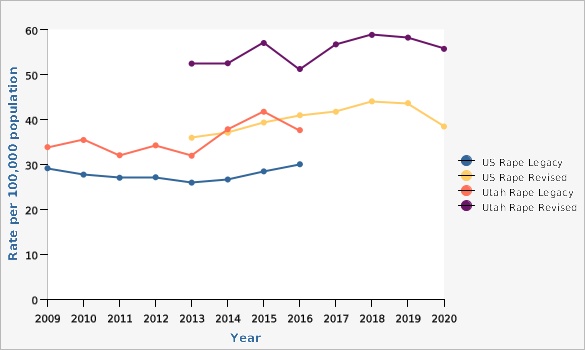
The Utah rape rate is higher in Utah than the U.S..
| Utah vs. U.S. | Year | Rate per 100,000 population | ||||
|---|---|---|---|---|---|---|
Record Count: 32 | ||||||
| US Rape Legacy | 2009 | 29.1 | ||||
| US Rape Legacy | 2010 | 27.7 | ||||
| US Rape Legacy | 2011 | 27.0 | ||||
| US Rape Legacy | 2012 | 27.1 | ||||
| US Rape Legacy | 2013 | 25.9 | ||||
| US Rape Legacy | 2014 | 26.6 | ||||
| US Rape Legacy | 2015 | 28.4 | ||||
| US Rape Legacy | 2016 | 30.0 | ||||
| US Rape Revised | 2013 | 35.9 | ||||
| US Rape Revised | 2014 | 37.0 | ||||
| US Rape Revised | 2015 | 39.3 | ||||
| US Rape Revised | 2016 | 40.9 | ||||
| US Rape Revised | 2017 | 41.7 | ||||
| US Rape Revised | 2018 | 44.0 | ||||
| US Rape Revised | 2019 | 43.6 | ||||
| US Rape Revised | 2020 | 38.4 | ||||
| Utah Rape Legacy | 2009 | 33.8 | ||||
| Utah Rape Legacy | 2010 | 35.4 | ||||
| Utah Rape Legacy | 2011 | 32.0 | ||||
| Utah Rape Legacy | 2012 | 34.2 | ||||
| Utah Rape Legacy | 2013 | 31.9 | ||||
| Utah Rape Legacy | 2014 | 37.8 | ||||
| Utah Rape Legacy | 2015 | 41.7 | ||||
| Utah Rape Legacy | 2016 | 37.6 | ||||
| Utah Rape Revised | 2013 | 52.4 | ||||
| Utah Rape Revised | 2014 | 52.5 | ||||
| Utah Rape Revised | 2015 | 57.0 | ||||
| Utah Rape Revised | 2016 | 51.2 | ||||
| Utah Rape Revised | 2017 | 56.7 | ||||
| Utah Rape Revised | 2018 | 58.8 | ||||
| Utah Rape Revised | 2019 | 58.2 | ||||
| Utah Rape Revised | 2020 | 55.7 | ||||
Data Notes
The '''revised''' definition is used for adult forcible rape: penetration, no matter how slight, of the vagina or anus with any body part or object, or oral penetration by a sex organ of another person, without the consent of the victim.Data Source
U.S. Department of Justice, Federal Bureau of InvestigationForcible Rape (Adult) by County, Utah, 2018-2020
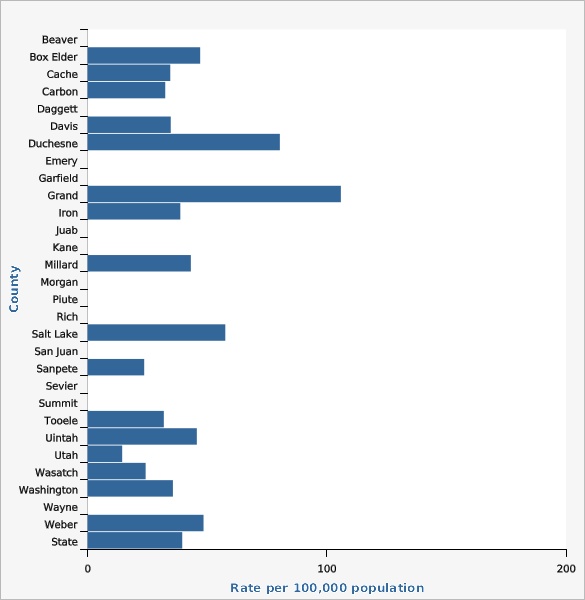

These numbers include only those cases of rape that meet the '''revised ''' definition and were reported to law enforcement. In 2018-2020, the rape rate in three counties was significantly higher than the state average: Weber, Salt Lake, Duchesne, and Grand counties. Additionally, the rape rate was lower than the state average in Davis, Wasatch, Sanpete, and Utah counties.
The '''revised''' definition is used for adult forcible rape: penetration, no matter how slight, of the vagina or anus with any body part or object, or oral penetration by a sex organ of another person, without the consent of the victim.
| County | Rate per 100,000 population | Lower Limit | Upper Limit | Note | Numer- ator | Denom- inator |
|---|---|---|---|---|---|---|
Record Count: 30 | ||||||
| Beaver | ** | *** | ||||
| Box Elder | 47.1 | 35.6 | 61.2 | 56 | 118,771 | |
| Cache | 34.6 | 28.9 | 40.9 | 133 | 384,887 | |
| Carbon | 32.5 | 19.8 | 50.2 | 20 | 61,484 | |
| Daggett | ** | * | ||||
| Davis | 34.8 | 31.3 | 38.5 | 371 | 1,065,690 | |
| Duchesne | 80.4 | 59.3 | 106.6 | 48 | 59,673 | |
| Emery | ** | * | ||||
| Garfield | ** | * | ||||
| Grand | 105.9 | 71.9 | 150.2 | 31 | 29,284 | |
| Iron | 38.8 | 29.8 | 49.5 | 64 | 165,042 | |
| Juab | ** | ** | ||||
| Kane | ** | ** | ||||
| Millard | 43.2 | 25.1 | 69.1 | 17 | 39,368 | |
| Morgan | ** | ** | ||||
| Piute | ** | * | ||||
| Rich | ** | * | ||||
| Salt Lake | 57.6 | 55.0 | 60.1 | 2,001 | 3,473,051 | |
| San Juan | ** | *** | ||||
| Sanpete | 23.7 | 14.8 | 35.8 | 22 | 92,908 | |
| Sevier | ** | ** | ||||
| Summit | ** | *** | ||||
| Tooele | 31.9 | 24.7 | 40.3 | 69 | 216,568 | |
| Uintah | 45.7 | 33.8 | 60.4 | 49 | 107,183 | |
| Utah | 14.5 | 12.8 | 16.2 | 276 | 1,908,810 | |
| Wasatch | 24.3 | 15.7 | 35.9 | 25 | 102,788 | |
| Washington | 35.7 | 30.8 | 41.1 | 191 | 534,902 | |
| Wayne | ** | * | ||||
| Weber | 48.5 | 43.7 | 53.6 | 377 | 777,792 | |
| State | 39.6 | 38.3 | 40.8 | 3,787 | 9,559,415 | |
Data Notes
[[br]]*The agencies in this county did not report data during the 2018-2020 time frame. [[br]]**Use caution in interpreting, the estimate has a relative standard error greater than 30% and does not meet UDOH standards for reliability. [[br]]***The estimate has been suppressed because the observed number of events is very small and not appropriate for publication. Some law enforcement agencies do not submit a full 12 months of data and some agencies do not submit any data at all. The numerator of the rate is by county of occurrence, not county of residence. The denominator of the rate is number of residence in county.Data Sources
- Bureau of Criminal Identification, Utah Department of Public Safety
- Population Estimates: National Center for Health Statistics (NCHS) through a collaborative agreement with the U.S. Census Bureau, IBIS Version 2018
Health Outcome Lifetime SV vs. No Lifetime SV 2018
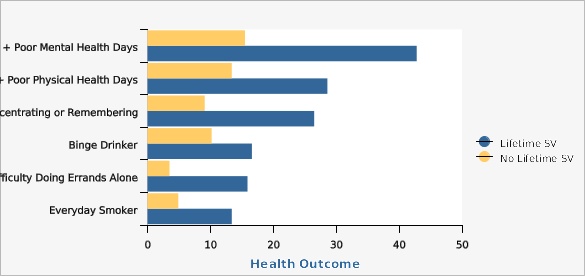
Among Utahns who are survivors of rape, percentages of negative health outcomes are higher, 7+ poor mental health days (42.8% vs. 15.5%), 7+ poor physical health days (28.6% vs. 13.4%), difficulty concentrating or remembering (26.5% vs. 9.1%), binge drinking (16.6% vs. 10.2%), difficulty doing errands along (15.9% vs. 3.5%), smoking everyday (13.4% vs. 4.9%).
Data Sources
- Bureau of Criminal Identification, Utah Department of Public Safety
- Utah Data: Behavioral Risk Factor Surveillance System, Office of Public Health Assessment, Utah Department of Health
- U.S. Department of Justice, Federal Bureau of Investigation
Students Who Reported They Have Ever Been Physically Forced to Have Sexual Intercourse When They Did Not Want To, Grades 9-12, Utah and U.S., 2003-2019
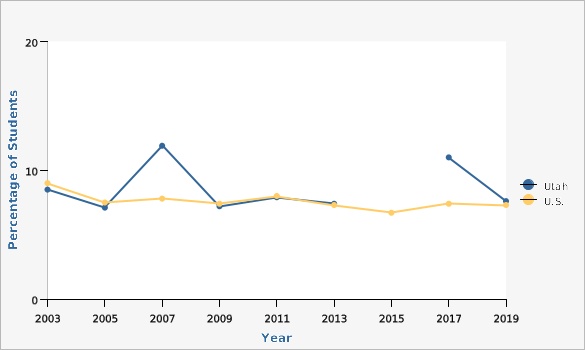
Approximately 1/13 Utah students have been physically forced to have sexual intercourse.
| Utah vs. U.S. | Year | Percentage of Students | ||||
|---|---|---|---|---|---|---|
Record Count: 18 | ||||||
| Utah | 2003 | 8.5% | ||||
| Utah | 2005 | 7.1% | ||||
| Utah | 2007 | 11.9% | ||||
| Utah | 2009 | 7.2% | ||||
| Utah | 2011 | 7.9% | ||||
| Utah | 2013 | 7.4% | ||||
| Utah | 2015 | ** | ||||
| Utah | 2017 | 11.0% | ||||
| Utah | 2019 | 7.6% | ||||
| U.S. | 2003 | 9.0% | ||||
| U.S. | 2005 | 7.5% | ||||
| U.S. | 2007 | 7.8% | ||||
| U.S. | 2009 | 7.4% | ||||
| U.S. | 2011 | 8.0% | ||||
| U.S. | 2013 | 7.3% | ||||
| U.S. | 2015 | 6.7% | ||||
| U.S. | 2017 | 7.4% | ||||
| U.S. | 2019 | 7.3% | ||||
Data Source
Youth Risk Behavior Surveillance System, National Center for Chronic Disease Prevention and Health PromotionReferences and Community Resources
Sexual violence resources and information can be found on the following websites: Violence and Injury Prevention Program, Utah Department of Health[[br]] [http://www.health.utah.gov/vipp/topics/rape-sexual-assault/] Commission on Criminal and Juvenile Justice Utah Office on Domestic & Sexual Violence [[br]] [https://justice.utah.gov/Violence/] Utah Coalition Against Sexual Assault[[br]] [http://www.ucasa.org] National Sexual Violence Resource Center[[br]] [http://www.nsvrc.org] Rape, Abuse and Incest National Network[[br]] [https://www.rainn.org/index.php] PreventConnect[[br]] [http://www.preventconnect.org]More Resources and Links
Evidence-based community health improvement ideas and interventions may be found at the following sites:- Centers for Disease Control and Prevention (CDC) WONDER Database, a system for disseminating public health data and information.
- United States Census Bureau data dashboard.
- Utah healthy Places Index, evidence-based and peer-reviewed tool, supports efforts to prioritize equitable community investments, develop critical programs and policies across the state, and much more.
- County Health Rankings
- Kaiser Family Foundation's StateHealthFacts.org
- Medical literature can be queried at PubMed library.
Page Content Updated On 10/27/2021,
Published on 11/04/2021