
Complete Health Indicator Report of Prostate Cancer Deaths
Definition
The rate of death from cancer of the prostate (ICD-10: C61) per 100,000 men.Numerator
The number of deaths due to prostate cancer for a given year (ICD-10: C61).Denominator
The male population in Utah or the U.S. for a given year.Why Is This Important?
Prostate cancer is the second most commonly occurring form of cancer for men, and is the second leading cause of cancer death for men in both Utah and the U.S.Healthy People Objective C-7:
Reduce the prostate cancer death rateU.S. Target: 21.8 deaths per 100,000 males
Other Objectives
CSTE Chronic Disease IndicatorsHow Are We Doing?
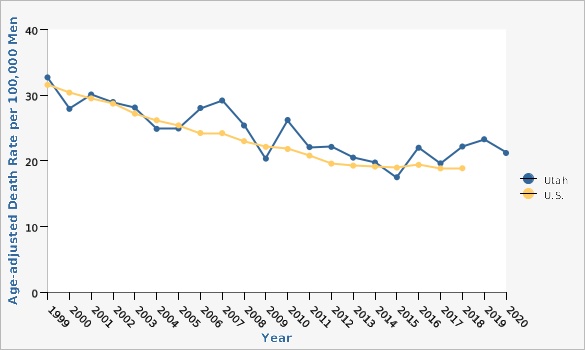
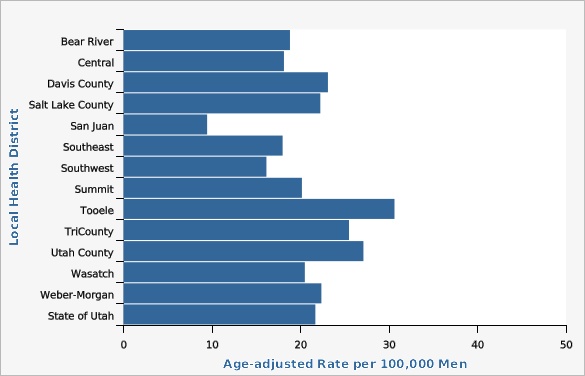
In 2020, the Utah age-adjusted prostate cancer mortality rate was 21.2 deaths per 100,000 males. Tooele County Local Health District (LHD) had the highest prostate cancer mortality rate at 30.6 per 100,000 and the San Juan LHD had the lowest at 9.5 per 100,000, though caution should be used in interpreting the San Juan LHD rate as it has a high coefficient of variation (see additional data views for additional differences between Utah Small Areas) from 2016-2020. From 2016-2020, men who racially identify as Asian had a significantly lower rate of prostate cancer mortality (6.6 deaths per 100,000 males, though caution should be used in interpreting these rates as these estimates have a high coefficient of variation), while men who racially identify as Pacific Islander had a significantly higher rate of prostate cancer mortality (37.1 per 100,000 males) compared to other races.How Do We Compare With the U.S.?
The U.S. prostate cancer age-adjusted mortality rate has generally been decreasing over time, from 24.2 deaths per 100,000 males in 2007 to 18.9 deaths per 100,000 males in 2018. The Utah age-adjusted prostate cancer mortality rate trend has been more variable from year-to-year, though rates have generally been similar to the national rate. In 2018, the Utah age-adjusted prostate cancer mortality rate was 22.2 deaths per 100,000 males while the national rate was 18.9 deaths per 100,000 males.What Is Being Done?
The Utah Comprehensive Cancer Control program (CCC) and its affiliated coalition, the Utah Cancer Action Network (UCAN), work together with state and local partners to reduce the burden of cancer in Utah. Their mission is to lower cancer incidence, morbidity, and mortality in Utah through collaborative efforts directed toward cancer prevention and control. As a result, they support community-based strategies around food security, healthy neighborhoods, access to health care, and financial toxicity in order to prevent cancer; detect cancer early; and improve the lives of cancer survivors, caregivers, and their families.Evidence-based Practices
Screening recommendations have changed over time. Until recently, many doctors and professional organizations encouraged yearly PSA screening for men beginning at age 50. However, as more has been learned about both the benefits and harms of prostate cancer screening, a number of organizations have begun to caution against routine population screening. Although some organizations continue to recommend PSA screening, there is widespread agreement that any man who is considering getting tested should first be informed in detail about the potential harms and benefits. Since 2018, the U.S. Preventive Services Task Force (USPSTF) recommends that those aged 55-69 with a prostate discuss the potential benefits and potential harms of prostate-specific antigen (PSA)-based screening for prostate cancer before deciding on whether or not to be screened. Healthy diet, exercise, and lifestyle play an important role in cancer prevention.Available Services
Currently, Medicare provides coverage for an annual PSA test for all Medicare-eligible men age 50 and older. Many private insurers cover regular PSA screening tests as well. Check with your insurance provider and doctor's office to discuss when prostate cancer screening may be right for you.Related Indicators
Relevant Population Characteristics
The risk of developing prostate cancer significantly increases with age. Risk for prostate cancer may also be increased based on family history of prostate cancer and potential mutations in genes passed hereditarily.Related Relevant Population Characteristics Indicators:
Related Health Care System Factors Indicators:
Risk Factors
Risk factors for prostate cancer include increasing age, a family history of prostate cancer, and certain hereditary syndromes.Related Risk Factors Indicators:
Health Status Outcomes
Current recommendations state those aged 55-69 with a prostate discuss the potential harms and potential benefits of prostate-specific antigen (PSA)-based screening for prostate cancer with a healthcare professional before deciding whether or not to be screened. For some men, there is a small potential benefit of screening to reduce the chance of death from prostate cancer.Related Health Status Outcomes Indicators:
Graphical Data Views
Prostate Cancer Deaths per 100,000 Men by Year, Utah and U.S., 1999-2020

| Utah vs. U.S. | Year | Age-adjusted Death Rate per 100,000 Men | Lower Limit | Upper Limit | ||
|---|---|---|---|---|---|---|
Record Count: 42 | ||||||
| Utah | 1999 | 32.7 | 28.2 | 37.8 | ||
| Utah | 2000 | 27.9 | 23.7 | 32.6 | ||
| Utah | 2001 | 30.1 | 25.8 | 34.9 | ||
| Utah | 2002 | 29.0 | 24.8 | 33.6 | ||
| Utah | 2003 | 28.1 | 24.1 | 32.6 | ||
| Utah | 2004 | 24.9 | 21.2 | 29.0 | ||
| Utah | 2005 | 24.9 | 21.3 | 29.0 | ||
| Utah | 2006 | 28.0 | 24.2 | 32.3 | ||
| Utah | 2007 | 29.2 | 25.4 | 33.4 | ||
| Utah | 2008 | 25.4 | 22.0 | 29.2 | ||
| Utah | 2009 | 20.3 | 17.3 | 23.8 | ||
| Utah | 2010 | 26.2 | 22.8 | 30.0 | ||
| Utah | 2011 | 22.1 | 19.0 | 25.5 | ||
| Utah | 2012 | 22.1 | 19.1 | 25.4 | ||
| Utah | 2013 | 20.5 | 17.7 | 23.6 | ||
| Utah | 2014 | 19.8 | 17.0 | 22.8 | ||
| Utah | 2015 | 17.5 | 15.0 | 20.3 | ||
| Utah | 2016 | 22.0 | 19.2 | 25.1 | ||
| Utah | 2017 | 19.6 | 17.0 | 22.5 | ||
| Utah | 2018 | 22.2 | 19.5 | 25.2 | ||
| Utah | 2019 | 23.3 | 20.6 | 26.2 | ||
| Utah | 2020 | 21.2 | 18.7 | 24.0 | ||
| U.S. | 1999 | 31.6 | 31.2 | 31.9 | ||
| U.S. | 2000 | 30.4 | 30.0 | 30.7 | ||
| U.S. | 2001 | 29.5 | 29.2 | 29.8 | ||
| U.S. | 2002 | 28.7 | 28.4 | 29.0 | ||
| U.S. | 2003 | 27.2 | 26.9 | 27.5 | ||
| U.S. | 2004 | 26.2 | 25.9 | 26.5 | ||
| U.S. | 2005 | 25.4 | 25.1 | 25.7 | ||
| U.S. | 2006 | 24.2 | 24.0 | 24.5 | ||
| U.S. | 2007 | 24.2 | 24.0 | 24.5 | ||
| U.S. | 2008 | 23.0 | 22.7 | 23.3 | ||
| U.S. | 2009 | 22.1 | 21.9 | 22.4 | ||
| U.S. | 2010 | 21.8 | 21.6 | 22.1 | ||
| U.S. | 2011 | 20.8 | 20.5 | 21.0 | ||
| U.S. | 2012 | 19.6 | 19.3 | 19.8 | ||
| U.S. | 2013 | 19.3 | 19.0 | 19.5 | ||
| U.S. | 2014 | 19.1 | 18.9 | 19.4 | ||
| U.S. | 2015 | 19.0 | 18.7 | 19.2 | ||
| U.S. | 2016 | 19.4 | 19.2 | 19.6 | ||
| U.S. | 2017 | 18.8 | 18.6 | 19.1 | ||
| U.S. | 2018 | 18.9 | 18.7 | 19.1 | ||
Data Notes
ICD-10 codes used to define prostate cancer: C61. [[br]] Age-adjusted to U.S. 2000 standard population.Data Sources
- Utah Death Certificate Database, Office of Vital Records and Statistics, Utah Department of Health
- Population Estimates: National Center for Health Statistics (NCHS) through a collaborative agreement with the U.S. Census Bureau, IBIS Version 2020
- U.S. Cancer Statistics: WONDER Online Database. United States Department of Health and Human Services, Centers for Disease Control and Prevention and National Cancer Institute. Accessed at [http://wonder.cdc.gov/cancer.html]
- National Vital Statistics System, National Center for Health Statistics, U.S. Centers for Disease Control and Prevention
Prostate Cancer Deaths by Local Health District, Utah, 2016-2020
| Local Health District | Age-adjusted Rate per 100,000 Men | Lower Limit | Upper Limit | Note | ||
|---|---|---|---|---|---|---|
Record Count: 14 | ||||||
| Bear River | 18.8 | 14.4 | 24.1 | |||
| Central | 18.1 | 12.8 | 24.9 | |||
| Davis County | 23.1 | 19.3 | 27.4 | |||
| Salt Lake County | 22.2 | 20.1 | 24.5 | |||
| San Juan | 9.4 | 2.5 | 24.4 | * | ||
| Southeast | 18.0 | 10.8 | 28.0 | |||
| Southwest | 16.2 | 13.5 | 19.2 | |||
| Summit | 20.2 | 11.0 | 34.0 | |||
| Tooele | 30.6 | 20.0 | 44.9 | |||
| TriCounty | 25.5 | 16.8 | 37.1 | |||
| Utah County | 27.1 | 23.6 | 31.1 | |||
| Wasatch | 20.5 | 10.4 | 36.3 | |||
| Weber-Morgan | 22.4 | 18.4 | 26.9 | |||
| State of Utah | 21.7 | 20.5 | 23.0 | |||
Data Notes
ICD-10 codes used to define prostate cancer: C61. [[br]]Age-adjusted to U.S. 2000 standard population.[[br]] ^ ^*Use caution in interpreting, the estimate has a relative standard error greater than 30% and does not meet UDOH standards for reliability. For more information, please go to [http://ibis.health.utah.gov/pdf/resource/DataSuppression.pdf].[[br]] Note: Prior to 2015 San Juan County was part of the Southeast Local Health District. In 2015 the San Juan County Local Health District was formed. Data reported are for all years using the current boundaries.Data Sources
- Utah Death Certificate Database, Office of Vital Records and Statistics, Utah Department of Health
- Population Estimates: National Center for Health Statistics (NCHS) through a collaborative agreement with the U.S. Census Bureau, IBIS Version 2020
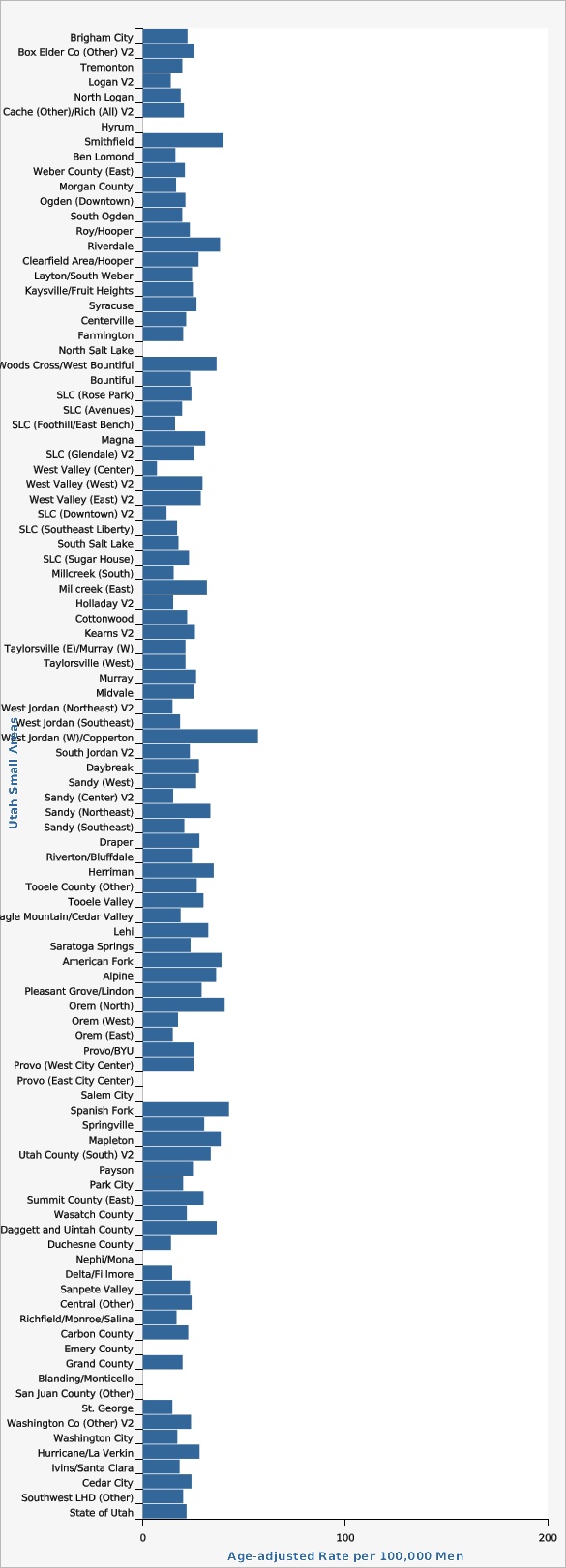
Prostate Cancer Deaths by Utah Small Area, 2016-2020
| Utah Small Areas | Age-adjusted Rate per 100,000 Men | Lower Limit | Upper Limit | Note | ||
|---|---|---|---|---|---|---|
Record Count: 103 | ||||||
| Brigham City | 22.1 | 11.4 | 38.7 | |||
| Box Elder Co (Other) V2 | 25.4 | 9.1 | 55.8 | * | ||
| Tremonton | 19.6 | 7.1 | 42.8 | * | ||
| Logan V2 | 13.9 | 7.2 | 24.3 | |||
| North Logan | 18.8 | 7.5 | 38.7 | * | ||
| Cache (Other)/Rich (All) V2 | 20.4 | 9.0 | 39.6 | * | ||
| Hyrum | ** | ** | ||||
| Smithfield | 39.9 | 17.2 | 78.8 | * | ||
| Ben Lomond | 16.2 | 9.5 | 25.8 | |||
| Weber County (East) | 20.9 | 12.4 | 33.0 | |||
| Morgan County | 16.5 | 4.1 | 44.2 | * | ||
| Ogden (Downtown) | 21.1 | 11.1 | 36.4 | |||
| South Ogden | 19.6 | 11.6 | 31.0 | |||
| Roy/Hooper | 23.3 | 14.2 | 36.1 | |||
| Riverdale | 38.2 | 23.9 | 57.9 | |||
| Clearfield Area/Hooper | 27.6 | 16.6 | 43.1 | |||
| Layton/South Weber | 24.4 | 16.2 | 35.3 | |||
| Kaysville/Fruit Heights | 24.8 | 13.6 | 41.4 | |||
| Syracuse | 26.6 | 10.0 | 57.0 | * | ||
| Centerville | 21.5 | 9.2 | 42.6 | * | ||
| Farmington | 20.0 | 7.0 | 44.6 | * | ||
| North Salt Lake | ** | ** | ||||
| Woods Cross/West Bountiful | 36.5 | 12.0 | 84.4 | * | ||
| Bountiful | 23.4 | 16.5 | 32.4 | |||
| SLC (Rose Park) | 24.1 | 11.9 | 43.4 | * | ||
| SLC (Avenues) | 19.5 | 10.0 | 34.2 | |||
| SLC (Foothill/East Bench) | 16.0 | 7.4 | 30.2 | * | ||
| Magna | 30.9 | 13.4 | 60.7 | * | ||
| SLC (Glendale) V2 | 25.3 | 10.8 | 50.3 | * | ||
| West Valley (Center) | 7.0 | 2.8 | 14.8 | * | ||
| West Valley (West) V2 | 29.6 | 12.0 | 60.4 | * | ||
| West Valley (East) V2 | 28.7 | 16.5 | 46.4 | |||
| SLC (Downtown) V2 | 11.8 | 5.0 | 23.6 | * | ||
| SLC (Southeast Liberty) | 17.0 | 5.5 | 39.7 | * | ||
| South Salt Lake | 17.7 | 7.2 | 36.2 | * | ||
| SLC (Sugar House) | 22.9 | 13.8 | 35.8 | |||
| Millcreek (South) | 15.3 | 8.3 | 25.9 | |||
| Millcreek (East) | 31.7 | 20.1 | 47.7 | |||
| Holladay V2 | 15.1 | 8.2 | 25.5 | |||
| Cottonwood | 22.0 | 14.8 | 31.4 | |||
| Kearns V2 | 25.8 | 12.7 | 46.6 | |||
| Taylorsville (E)/Murray (W) | 21.1 | 11.3 | 36.1 | |||
| Taylorsville (West) | 21.2 | 10.8 | 37.3 | |||
| Murray | 26.4 | 16.4 | 40.1 | |||
| Midvale | 25.2 | 13.7 | 42.5 | |||
| West Jordan (Northeast) V2 | 14.7 | 5.3 | 32.5 | * | ||
| West Jordan (Southeast) | 18.5 | 7.7 | 37.2 | * | ||
| West Jordan (W)/Copperton | 56.9 | 26.2 | 107.7 | * | ||
| South Jordan V2 | 23.3 | 13.6 | 37.4 | |||
| Daybreak | 27.8 | 10.2 | 60.7 | * | ||
| Sandy (West) | 26.4 | 14.4 | 44.4 | |||
| Sandy (Center) V2 | 15.0 | 5.8 | 31.6 | * | ||
| Sandy (Northeast) | 33.4 | 19.1 | 54.4 | |||
| Sandy (Southeast) | 20.6 | 9.9 | 37.8 | |||
| Draper | 28.0 | 14.4 | 49.1 | |||
| Riverton/Bluffdale | 24.3 | 12.3 | 42.9 | |||
| Herriman | 35.1 | 14.4 | 71.5 | * | ||
| Tooele County (Other) | 26.7 | 9.4 | 59.4 | * | ||
| Tooele Valley | 30.0 | 18.2 | 46.6 | |||
| Eagle Mountain/Cedar Valley | 18.7 | 4.4 | 51.4 | * | ||
| Lehi | 32.4 | 19.3 | 51.0 | |||
| Saratoga Springs | 23.6 | 7.3 | 56.6 | * | ||
| American Fork | 38.9 | 25.2 | 57.5 | |||
| Alpine | 36.3 | 14.4 | 75.4 | * | ||
| Pleasant Grove/Lindon | 29.1 | 17.8 | 45.0 | |||
| Orem (North) | 40.5 | 23.7 | 64.6 | |||
| Orem (West) | 17.5 | 7.9 | 33.5 | * | ||
| Orem (East) | 14.9 | 6.4 | 29.4 | * | ||
| Provo/BYU | 25.5 | 16.2 | 38.1 | |||
| Provo (West City Center) | 25.1 | 10.6 | 50.3 | * | ||
| Provo (East City Center) | ** | ** | ||||
| Salem City | ** | ** | ||||
| Spanish Fork | 42.6 | 25.7 | 66.5 | |||
| Springville | 30.4 | 16.9 | 50.4 | |||
| Mapleton | 38.6 | 13.9 | 84.9 | * | ||
| Utah County (South) V2 | 33.6 | 11.5 | 76.2 | * | ||
| Payson | 24.8 | 11.5 | 46.6 | * | ||
| Park City | 20.0 | 8.1 | 40.9 | * | ||
| Summit County (East) | 30.1 | 11.4 | 64.4 | * | ||
| Wasatch County | 21.8 | 11.2 | 38.4 | |||
| Daggett and Uintah County | 36.6 | 22.7 | 55.8 | |||
| Duchesne County | 14.0 | 4.8 | 31.5 | * | ||
| Nephi/Mona | ** | ** | ||||
| Delta/Fillmore | 14.6 | 3.8 | 38.1 | * | ||
| Sanpete Valley | 23.4 | 11.4 | 42.5 | * | ||
| Central (Other) | 24.2 | 13.7 | 39.6 | |||
| Richfield/Monroe/Salina | 16.7 | 6.7 | 34.5 | * | ||
| Carbon County | 22.5 | 11.5 | 39.7 | |||
| Emery County | ** | ** | ||||
| Grand County | 19.7 | 6.2 | 46.8 | * | ||
| Blanding/Monticello | ** | ** | ||||
| San Juan County (Other) | ** | ** | ||||
| St. George | 14.7 | 10.8 | 19.5 | |||
| Washington Co (Other) V2 | 23.9 | 11.8 | 43.0 | * | ||
| Washington City | 17.1 | 8.8 | 30.0 | |||
| Hurricane/La Verkin | 28.1 | 16.7 | 44.3 | |||
| Ivins/Santa Clara | 18.2 | 8.2 | 34.9 | * | ||
| Cedar City | 24.1 | 13.9 | 38.9 | |||
| Southwest LHD (Other) | 20.0 | 11.1 | 33.3 | |||
| State of Utah | 21.7 | 20.5 | 23.0 | |||
Data Notes
ICD-10 codes used to define prostate cancer: C61. [[br]] Age-adjusted to U.S. 2000 standard population using 11 age groups. [[br]] [[br]] *Use caution in interpreting, the estimate has a relative standard error greater than 30% and does not meet UDOH standards for reliability. For more information, please go to [http://ibis.health.utah.gov/pdf/resource/DataSuppression.pdf] [[br]] **The estimate has been suppressed because 1) the relative standard error is greater than 50% or the relative standard error can't be determined or 2) the observed number of events is very small and not appropriate for publication.[[br]] [[br]] A description of the Utah Small Areas and details about Small Area reclassification may be found on IBIS at the following URL: [https://ibis.health.utah.gov/resource/Guidelines.html].Data Sources
- Utah Death Certificate Database, Office of Vital Records and Statistics, Utah Department of Health
- Population Estimates: National Center for Health Statistics (NCHS) through a collaborative agreement with the U.S. Census Bureau, IBIS Version 2020
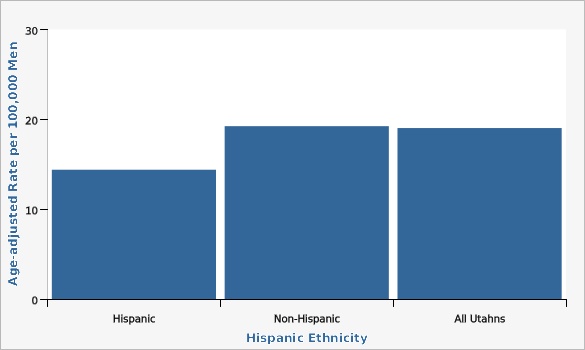
Prostate Cancer Deaths per 100,000 Men by Ethnicity, Utah, 2016-2020
| Hispanic Ethnicity | Age-adjusted Rate per 100,000 Men | Lower Limit | Upper Limit | |||
|---|---|---|---|---|---|---|
Record Count: 3 | ||||||
| Hispanic | 14.4 | 10.8 | 18.7 | |||
| Non-Hispanic | 19.2 | 18.2 | 20.4 | |||
| All Utahns | 19.0 | 18.0 | 20.1 | |||
Data Notes
ICD-10 codes used to define prostate cancer: C61. [[br]] Age-adjusted to U.S. 2000 standard population using 3 age groups, 0-44, 45-64, and 65+.Data Sources
- Utah Death Certificate Database, Office of Vital Records and Statistics, Utah Department of Health
- Population Estimates by Age, Sex, Race, and Hispanic Origin for Counties in Utah, U.S. Bureau of the Census, IBIS Version 2020
Prostate Cancer Deaths per 100,000 Men by Race, Utah, 2016-2020
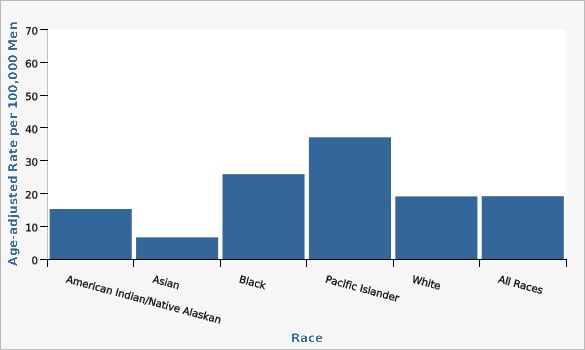
| Race | Age-adjusted Rate per 100,000 Men | Lower Limit | Upper Limit | Note | ||
|---|---|---|---|---|---|---|
Record Count: 6 | ||||||
| American Indian/Native Alaskan | 15.2 | 6.5 | 30.4 | * | ||
| Asian | 6.6 | 2.8 | 13.1 | * | ||
| Black | 25.9 | 12.8 | 46.6 | |||
| Pacific Islander | 37.1 | 20.6 | 61.5 | |||
| White | 19.1 | 18.0 | 20.2 | |||
| All Races | 19.2 | 18.1 | 20.3 | |||
Data Notes
ICD-10 codes used to define prostate cancer: C61. [[br]] Age-adjusted to U.S. 2000 standard population using 3 age groups, 0-44, 45-64, and 65+. [[br]] *Use caution in interpreting, the estimate has a relative standard error greater than 30% and does not meet UDOH standards for reliability. For more information, please go to [http://ibis.health.utah.gov/pdf/resource/DataSuppression.pdf].[[br]]Data Sources
- Utah Death Certificate Database, Office of Vital Records and Statistics, Utah Department of Health
- Population Estimates by Age, Sex, Race, and Hispanic Origin for Counties in Utah, U.S. Bureau of the Census, IBIS Version 2020
References and Community Resources
Utah Cancer Control Program: [http://www.cancerutah.org][[br]] Utah Cancer Action Network: [http://www.ucan.cc][[br]] American Cancer Society: [http://www.cancer.org][[br]] National Cancer Institute: [http://www.cancer.gov][[br]] Huntsman Cancer Institute: [http://www.huntsmancancer.org][[br]] Centers for Disease Control and Prevention: [http://www.cdc.gov][[br]] American Society of Clinical Oncology: [http://www.asco.org]More Resources and Links
Evidence-based community health improvement ideas and interventions may be found at the following sites:- Centers for Disease Control and Prevention (CDC) WONDER Database, a system for disseminating public health data and information.
- United States Census Bureau data dashboard.
- Utah healthy Places Index, evidence-based and peer-reviewed tool, supports efforts to prioritize equitable community investments, develop critical programs and policies across the state, and much more.
- County Health Rankings
- Kaiser Family Foundation's StateHealthFacts.org
- Medical literature can be queried at PubMed library.
Page Content Updated On 04/14/2022,
Published on 04/27/2022