
Complete Health Indicator Report of Infant and children enrolled on the WIC program who have an overweight BMI
Definition
Definitions used in this Indicator Report follow the current United States Department of Agriculture (USDA), and Women, Infants, and Children (WIC) program definitions, which are as follows: '''Overweight''' - children 2 to 5 years of age with a Body Mass Index (BMI)-for-age or weight-for-stature greater than or equal to the 85th percentile and less than the 95th percentile as plotted on the 2000 Centers for Disease Control and Prevention (CDC) 2-20 years gender-specific growth charts. '''At risk of overweight''' - children 12 months of age to 5 years of age that have a biological mother with a BMI greater than or equal to 30 at the time of the child's enrollment on the WIC program '''or''' children aged 12 months to 5 years who have a biological father with a BMI greater than or equal to 30 at the time of enrollment. '''Obese''' - children 2 to 5 years of age and greater than or equal to the 95th percentile BMI or weight-for-stature as plotted on the 2000 Centers for Disease Control and Prevention 2-20 years gender-specific growth charts. '''High weight-for-length''' (added in 2013) - children 12 to 24 months of age having a weight-for-length greater than or equal to the 97.7th percentile as plotted on the CDC Birth to 24 Months gender-specific growth charts.Numerator
__2000-2005, 2010__: The number of children enrolled in the Utah WIC program who met '''overweight''' or '''obese''' definitions (see Definition).[[br]] [[br]] __2011-2012__: The number of children enrolled in the Utah WIC program who met the '''at risk of overweight''' definition __and__ the number of children who met the '''overweight''' or '''obese''' definitions (see Definition).[[br]] [[br]] __2013-current__: The number of children enrolled in the Utah WIC program who meet the '''high weight-for-length''' or '''at risk of overweight''' definitions (see Definition) __and__ the number of children who meet '''overweight''' or '''obese''' definitions (see Definition).Denominator
__2000-2005, 2010__: The number of children aged 2 to 5 years enrolled in the Utah WIC program.[[br]] [[br]] __2011-current__: The number of children aged 12 months to 5 years enrolled in the Utah WIC program.Data Interpretation Issues
Centers for Disease Control and Prevention (CDC) Pediatric Nutrition Surveillance System (PedNSS) data was used through 2010. PedNSS used raw data submitted by WIC. The PedNSS provided nutrition surveillance reports for the nation defined as "all participating contributors" as well as for each contributor. A contributor may be a state, U.S. territory, or tribal government. Each contributor can receive more specific reports by the clinic, county, local agency, region, or metropolitan area. The data represents actual measurements taken in local WIC clinics or referral data from a healthcare provider's office. CDC discontinued the PedNSS nutrition surviellance report system as of 2011.[[br]] [[br]] Beginning in 2011, national data is from USDA's WIC Program and Participant Characteristic Survey. This survey is released every 2 years. Utah uses this data source for obesity rates only. However, Utah data for combined overweight, at risk for overweight, high weight-for-length, and obesity rates are from the WIC computer system VISION, created by Ciber (beginning in 2011).[[br]] [[br]] Utah data in 2015-2017 was significantly lower than previous years. There is evidence to show that the quality foods WIC provides (such as fresh fruits and vegetables, low-fat milk, and whole grains) contribute to healthier diets. This may be a reason for a decrease in these rates during these years.[[br]] [[br]] From 2020-2022, FNS provided waivers for all WIC clinics to complete visits remotely due to the COVID-19 pandemic. Anthropometric data is typically collected during in-person appointments. Remote appointments made it difficult to collect accurate data during this time. This may have contributed to the fluctuations in anthropometric data during these years.Why Is This Important?
Childhood overweight and obesity rates are a serious health problem in the United States. Children who meet the criteria for being considered overweight are at increased risk of high blood pressure, heart disease, type 2 diabetes mellitus, asthma, GERD, sleep apnea, bullying, social stigmatization, mental health conditions, and low self-esteem. There have been significant increases in the prevalence of children younger than 5 years of age who are considered overweight across all ethnic groups nationwide. For example, the number of preschool children who are considered overweight has doubled since the 1970s. A significant portion (25%) of adults who are considered obese were first classified as being overweight as a child. It's also important to note that children who are first classified as being overweight __before 8 years old__ are even __more likely__ to be considered obese as an adult.Other Objectives
The Healthy People 2030 Objectives include NWS-04: Reduce the proportion of children and adolescents with obesity. The goals and purpose of WIC align with this objective.How Are We Doing?
Nationwide, the number of infants and preschool aged children (children aged 3 to 4 years) who are considered overweight and obese has steadily increased. The highest rates are among Hispanic/Latino, Pacific Islander, and Alaskan Native/American Indian children aged 3 to 4 years.How Do We Compare With the U.S.?
The Food and Nutrition Service (FNS) WIC Participant and Program Characteristic Report is released every 2 years. This data provides nationwide information on WIC data. The Utah WIC program consistently has rates below the national average. This trend continues. Despite the higher prevalence of overweight and obesity rates in 2018 and 2020, they were still below the national average for WIC participants. We hope to maintain this progress in the future.What Is Being Done?
The Utah WIC program focuses on preventing the development of childhood overweight and obesity during pregnancy, infancy, and throughout childhood. [[br]] [[br]] Women's choices during pregnancy can influence the risk of childhood overweight and obesity. Utah WIC emphasizes the importance of gaining appropriate amounts of weight during pregnancy, consuming a healthy diet, and being physically active. WIC also encourages women to breastfeed their children for the recommended 12 months or more to prevent childhood obesity.[[br]] [[br]] To prevent the development of childhood overweight and obesity in infancy, Utah WIC continues to promote breastfeeding, and teaches parents about appropriately introducing complementary foods.[[br]] [[br]] WIC promotes overweight and obesity prevention in childhood by measuring and plotting children's measurements on growth charts, discussing the growth pattern with the parent/caregiver, teaching about healthy diets for children, teaching about physical activity, and providing nutrient-dense foods in the WIC Food Packages. [[br]] [[br]] If a child has an overweight or obese BMI, treatment primarily focuses on weight maintenance rather than weight loss. Weight maintenance is achieved through modest changes in diet and physical activity. It's important to avoid short term diets and physical activity programs that promote rapid weight loss. Caregivers are the best role models for young children and can model healthy eating and physically active lifestyles to emphasize their importance for the whole family. Utah WIC staff educate families about healthy dietary intakes and physical activity levels, help families set health behavior goals, and monitor changes and progress towards meeting these goals. General health behavior goals that can prevent and treat childhood overweight and obesity are listed below: [[br]] *Eat regular meals and snacks each day. *Choose foods from at least 2 to 3 food groups for each snack. *Choose nutrient-dense foods. These are foods that have more vitamins, minerals, and overall nutritional value than other foods. *Choose reduced fat dairy products (children less than 2 years of age should eat whole fat dairy products). *Limit the amount of foods and beverages with high amounts of sugar (soda, fruit drinks, candy). *Eat portion sizes that are appropriate for your age, body, and activity levels. *Choose whole and minimally processed foods over highly processed foods. *Eat foods from all 5 food groups every day. *Drink water throughout the day, especially between meals and snacks. *Be physically active every day. Choose activities the whole family can enjoy. *Limit screen time. Children 0 to 18 months old should have no screen time except for video-chatting with people they know. Limit screen time to 1 hour or less each day for children older than 18 months. [[br]] [[br]]Health Program Information
Utah WIC Program: 1-877-WIC-KIDS [[br]] [https://wic.utah.gov]Related Indicators
Related Relevant Population Characteristics Indicators:
Graphical Data Views
Percentage of WIC children aged 1 to 5 years old who are overweight, at risk for overweight, high weight-for-length*, or obese Utah vs. U.S., 2000-2023
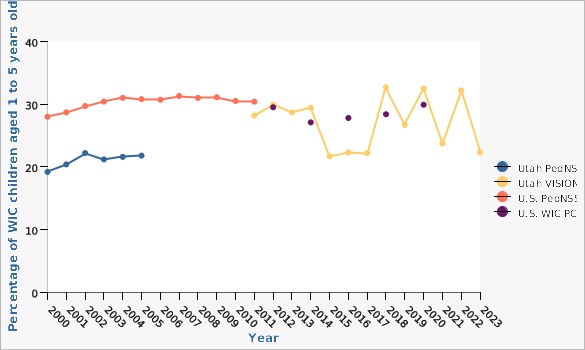
Please note a data gap existed from 2006 to 2010 due to a new computer system and the inability to receive and transfer data.
| Utah vs. U.S. WIC | Year | Percentage of WIC children aged 1 to 5 years old | ||||
|---|---|---|---|---|---|---|
Record Count: 36 | ||||||
| Utah PedNSS | 2000 | 19.2% | ||||
| Utah PedNSS | 2001 | 20.4% | ||||
| Utah PedNSS | 2002 | 22.2% | ||||
| Utah PedNSS | 2003 | 21.2% | ||||
| Utah PedNSS | 2004 | 21.6% | ||||
| Utah PedNSS | 2005 | 21.8% | ||||
| Utah VISION | 2011 | 28.2% | ||||
| Utah VISION | 2012 | 29.9% | ||||
| Utah VISION | 2013 | 28.7% | ||||
| Utah VISION | 2014 | 29.4% | ||||
| Utah VISION | 2015 | 21.7% | ||||
| Utah VISION | 2016 | 22.3% | ||||
| Utah VISION | 2017 | 22.2% | ||||
| Utah VISION | 2018 | 32.7% | ||||
| Utah VISION | 2019 | 26.7% | ||||
| Utah VISION | 2020 | 32.5% | ||||
| Utah VISION | 2021 | 23.7% | ||||
| Utah VISION | 2022 | 32.2% | ||||
| Utah VISION | 2023 | 22.3% | ||||
| U.S. PedNSS | 2000 | 28.0% | ||||
| U.S. PedNSS | 2001 | 28.7% | ||||
| U.S. PedNSS | 2002 | 29.7% | ||||
| U.S. PedNSS | 2003 | 30.4% | ||||
| U.S. PedNSS | 2004 | 31.0% | ||||
| U.S. PedNSS | 2005 | 30.8% | ||||
| U.S. PedNSS | 2006 | 30.7% | ||||
| U.S. PedNSS | 2007 | 31.3% | ||||
| U.S. PedNSS | 2008 | 31.0% | ||||
| U.S. PedNSS | 2009 | 31.1% | ||||
| U.S. PedNSS | 2010 | 30.5% | ||||
| U.S. PedNSS | 2011 | 30.4% | ||||
| U.S. WIC PC | 2012 | 29.5% | ||||
| U.S. WIC PC | 2014 | 27.1% | ||||
| U.S. WIC PC | 2016 | 27.8% | ||||
| U.S. WIC PC | 2018 | 28.4% | ||||
| U.S. WIC PC | 2020 | 29.9% | ||||
Data Notes
*High weight-for-length was not included until 2013. The data gap from the year 2006 to the year 2010 was associated with a failed WIC computer system. Data up to 2010 includes children 2-5 years only. Beginning in 2011, WIC's overweight data included 1-year-old children who were at risk of overweight, and starting in 2013, high weight-for-length as specified in the health indicator definition. Data from the WIC Participant and Program Characteristics report includes children 2-5 years only. The 2011 data were the last data available from PedNSS. The reported U.S. data from 2012 and later are from the WIC Participant and Program Characteristics (WIC PC) report which is released every two years. Because of the amount of missing and unreliable anthropometric data reported by state agencies for U.S. WIC PC 2022, anthropometric data was not included in the 2022 U.S. WIC PC report.Data Sources
- CDC Pediatric Nutrition Surveillance System (PedNSS)
- VISION computer system, Utah Women, Infants and Children (WIC) Program, Office of Maternal and Child Health, Utah Department of Health and Human Services
- WIC PC - WIC Participant and Program Characteristics, U.S. Department of Agriculture, Food and Nutrition Service
References and Community Resources
1. Academy of Nutrition and Dietetics Evidence Analysis Library. (2007). Pediatric weight management. [https://www.andeal.org/topic.cfm?cat=3013] 2. Academy of Nutrition and Dietetics Evidence Analysis Library. (2015). Pediatric weight management. [https://www.andeal.org/topic.cfm?menu=5296&cat=5633] 3. American Academy of Pediatrics. (2016, Nov 1). Where we stand: Screen time. [https://healthychildren.org/English/family-life/Media/Pages/Where-We-Stand-TV-Viewing-Time.aspx] 4. Centers for Disease Control and Prevention. (2016, Dec 15). Childhood obesity causes & consequences. [https://www.cdc.gov/obesity/childhood/causes.html] 5. Centers for Disease Control and Prevention. (2019, Jun 24). Childhood obesity facts. [https://www.cdc.gov/obesity/data/childhood.html] 6. Centers for Disease Control and Prevention. (2019, Nov 22). Obesity among WIC-enrolled young chidlren. [https://www.cdc.gov/obesity/data/obesity-among-WIC-enrolled-young-children.html] 7. Centers for Disease Control and Prevention. (2020, Feb 4). Tips for parents. [https://www.cdc.gov/healthyweight/children/index.html] 8. Cohen D. (2018). Interventions for treatment of overweight and obese children. American Family Physician 98(3), 151. 9. Healthy Eating Research. (2019 Sept). Healthy beverage consumption in early childhood: Recommendations from key national health and nutrition organizers. [https://healthydrinkshealthykids.org/app/uploads/2019/09/HER-HealthyBeverage-ConsensusStatement.pdf] 10. Hoelscher D.M., Kirk S., Ritchie L., & Cunningham-Sabo L. (2013). Position of the academy of nutrition and dietetics: Interventions for the prevention and treatment of pediatric overweight and obesity. Journal of the Academy of Nutrition and Dietetics 113(10), 1375-1394. DOI: 10.1016/j.jand.2013.08.004 11. Medline Plus. (2018, Aug 5). Causes and risks for childhood obesity. [https://medlineplus.gov/ency/patientinstructions/000383.htm] 12. U.S. Department of Agriculture. (2020, May). WIC participant and program characteristics report 2018. [https://www.fns.usda.gov/wic/wic-participant-and-program-characteristics-2018] 13. U.S. Department of Health and Human Services. (2011). Surgeon general's call to action to support breastfeeding. [https://www.hhs.gov/surgeongeneral/reports-and-publications/breastfeeding/index.html] 14. U.S. Department of Agriculture. (2022, February). WIC participant and program characteristics report 2020. [https://www.fns.usda.gov/wic/participant-program-characteristics-2020#:~:text=Key%20Findings%3A,breastfed%20at%20age%206%20months.] 15. U.S. Department of Agriculture. (2024, February). WIC participant and program characteristics report 2022. [https://www.fns.usda.gov/research/wic/participant-program-characteristics-2022#:~:text=Key%20Findings,2022%2C%20according%20to%20administrative%20data.]More Resources and Links
Evidence-based community health improvement ideas and interventions may be found at the following sites:- Centers for Disease Control and Prevention (CDC) WONDER Database, a system for disseminating public health data and information.
- United States Census Bureau data dashboard.
- Utah healthy Places Index, evidence-based and peer-reviewed tool, supports efforts to prioritize equitable community investments, develop critical programs and policies across the state, and much more.
- County Health Rankings
- Kaiser Family Foundation's StateHealthFacts.org
- Medical literature can be queried at PubMed library.
Page Content Updated On 12/11/2023,
Published on 03/04/2024